Most SMEs do not have a technology problem first; they have an information problem. Sales updates sit in one system, customer issues in another, and operational detail in spreadsheets, inboxes or the heads of key people. The result is familiar: slower follow-up, duplicated effort, missed context and decisions made on partial information.
AI does not have to replace those systems to be useful. Used well, it can act as an intelligence layer across existing tools, pulling together information, highlighting patterns and presenting the right next step to the right person. For SMEs that need practical value rather than a major overhaul, that is usually the better starting point.
Why disconnected systems slow SMEs down
When data is scattered, every team has to translate before it can act.
A salesperson may see an open opportunity, but not the latest service issue linked to that account. Operations may know a stock or capacity constraint is coming, but sales is still promising dates that no longer hold. Customer service may answer the same question repeatedly because it cannot easily see order status, contract history or previous conversations.
None of that requires a dramatic failure. It is often just the ordinary cost of tools that were introduced one at a time.
For SMEs, the practical effect is lost time in three places:
- searching for the latest version of the truth
- copying information between systems
- making decisions without the full picture
That is where AI can help, not by replacing everything, but by reducing the friction between systems you already use.
What an AI intelligence layer actually does
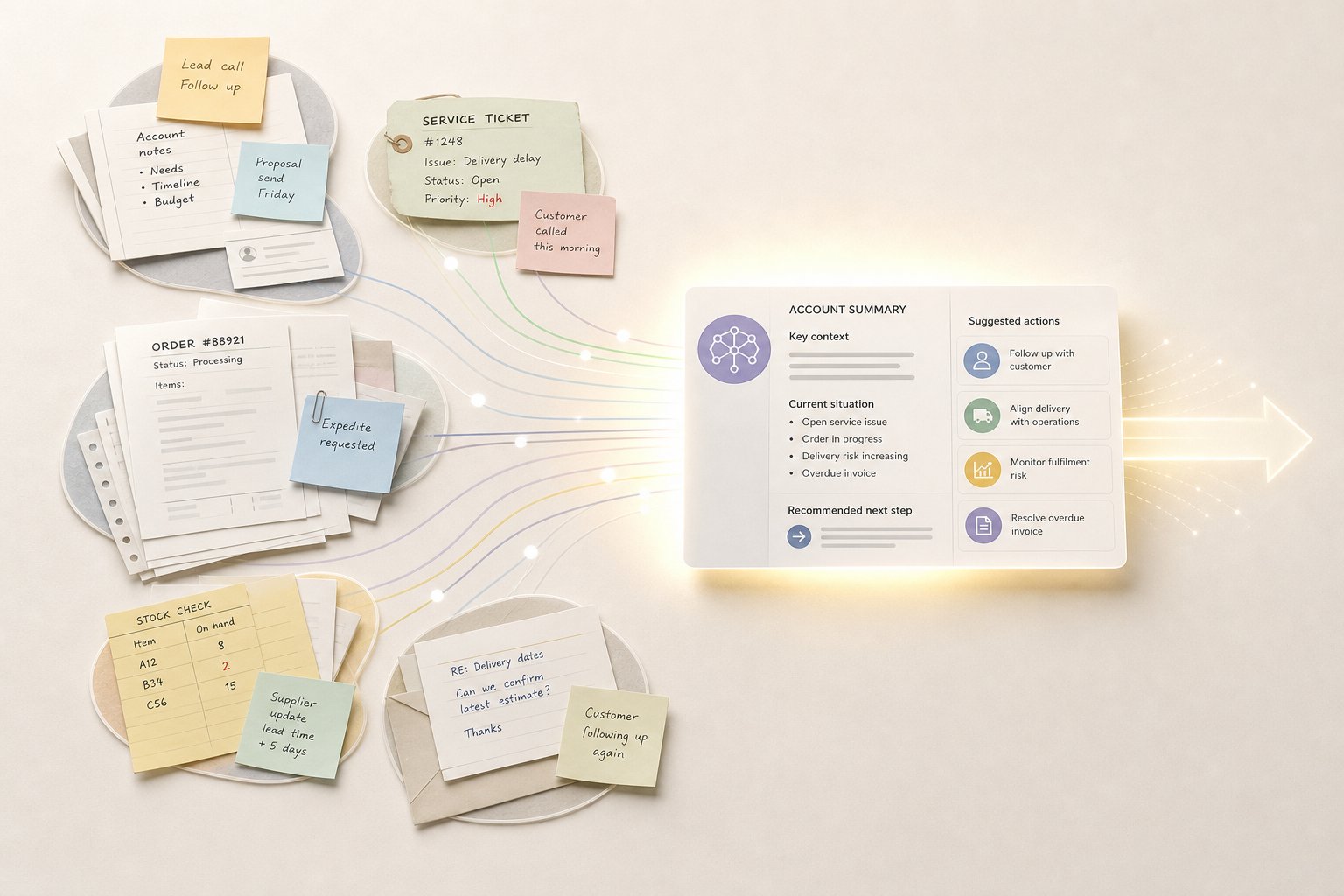
Think of it as a layer that reads across your existing data and turns it into something usable.
In plain English, an AI intelligence layer can:
- bring together information from CRM, ticketing, ERP, finance, email or shared files
- identify patterns that are hard to spot manually
- summarise what matters for a specific role or workflow
- surface exceptions, risks or follow-up actions
- support routine decisions with more context
The point is not to create another place where people must update records. The point is to make existing records more useful.
That distinction matters. If AI is used only as another dashboard, it can add noise. If it is connected to a clear process, it can save time and improve decision-making without demanding a full system rebuild.
For many SMEs, the smartest use of AI for SMEs is not a grand platform project. It is a targeted layer that sits between systems and makes one important workflow easier.
Three practical use cases across sales, operations and service
1. Sales: better context before a call
Sales teams often lose time chasing details that already exist somewhere else.
An AI layer can pull together account history, recent service issues, open orders, overdue invoices, lead notes and meeting summaries into one short brief before a call. That gives the salesperson a clearer view of the account and reduces the risk of offering something the business cannot deliver.
Used well, this improves follow-up quality as well as speed. It is easier to prioritise the right accounts, spot upsell opportunities and avoid awkward surprises.
2. Operations: earlier warning of bottlenecks
Operations leaders usually do not need more data. They need earlier warning.
AI can review patterns across orders, stock movement, workload, lead times or exception logs and flag where a bottleneck is forming. That does not mean it predicts the future with certainty. It means it can draw attention to combinations of signals that are easy to miss in day-to-day work.
For example, if fulfilment delays are rising in one product line while sales activity is increasing and supplier updates have changed, AI can help surface that risk sooner. The value is not perfect prediction. The value is giving managers more time to act.
3. Customer service: faster answers with better handover
Service teams often spend time collecting background before they can solve the real problem.
An AI layer can summarise the customer’s history, identify related orders or tickets, and suggest the most relevant next action. It can also help route cases to the right person when the issue touches more than one department.
That reduces repeat questions and shortens the handover between teams. It can also make service more consistent, because staff are working from the same joined-up picture rather than relying on memory or guesswork.
How to prioritise the first connected workflow
The first workflow should be the one where missing context creates a clear business cost.
A good starting point usually has four characteristics:
- The process happens often enough to matter.
- The information already exists in your current systems.
- The pain is visible to managers and staff.
- A better answer would save time, improve service or protect revenue.
That might be sales account preparation, overdue order follow-up, customer complaint handling or exception management in operations. The best choice is not necessarily the most impressive use case. It is the one with a simple path to measurable value.
A useful test is this: if the workflow disappeared tomorrow, would people notice the time saved and the quality improvement straight away? If not, it may be too small or too vague for a first project.
For SMEs, the aim is not to connect everything at once. It is to prove that one connected workflow works, then extend from there.
What success looks like in practice
Success should be visible in everyday work, not just in a project document.
You should expect to see some combination of:
- less time spent searching for information
- fewer manual handovers between teams
- quicker responses to customers
- better prioritisation of accounts, cases or actions
- more consistent decisions because the same context is available to everyone involved
You may also see a quieter but important benefit: fewer mistakes caused by people working from partial data.
That is the real measure of a useful AI intelligence layer. It should reduce friction, not add another layer of process. It should help people act with more confidence, not force them to learn a new system from scratch.
Start small, connect one workflow, then build
SMEs do not need to rebuild their stack to get value from AI. In many cases, the better route is to connect what already exists, choose one workflow with a clear business impact and use AI to make that workflow smarter.
That approach keeps the risk manageable and the value easier to prove. It also gives owners and managers a practical way to learn what works before they invest more widely.
If you want a sensible first step, start with an AI opportunity assessment focused on one process, one pain point and one measurable outcome. That is usually the fastest way to move from scattered data to useful decision support without overcomplicating the business.