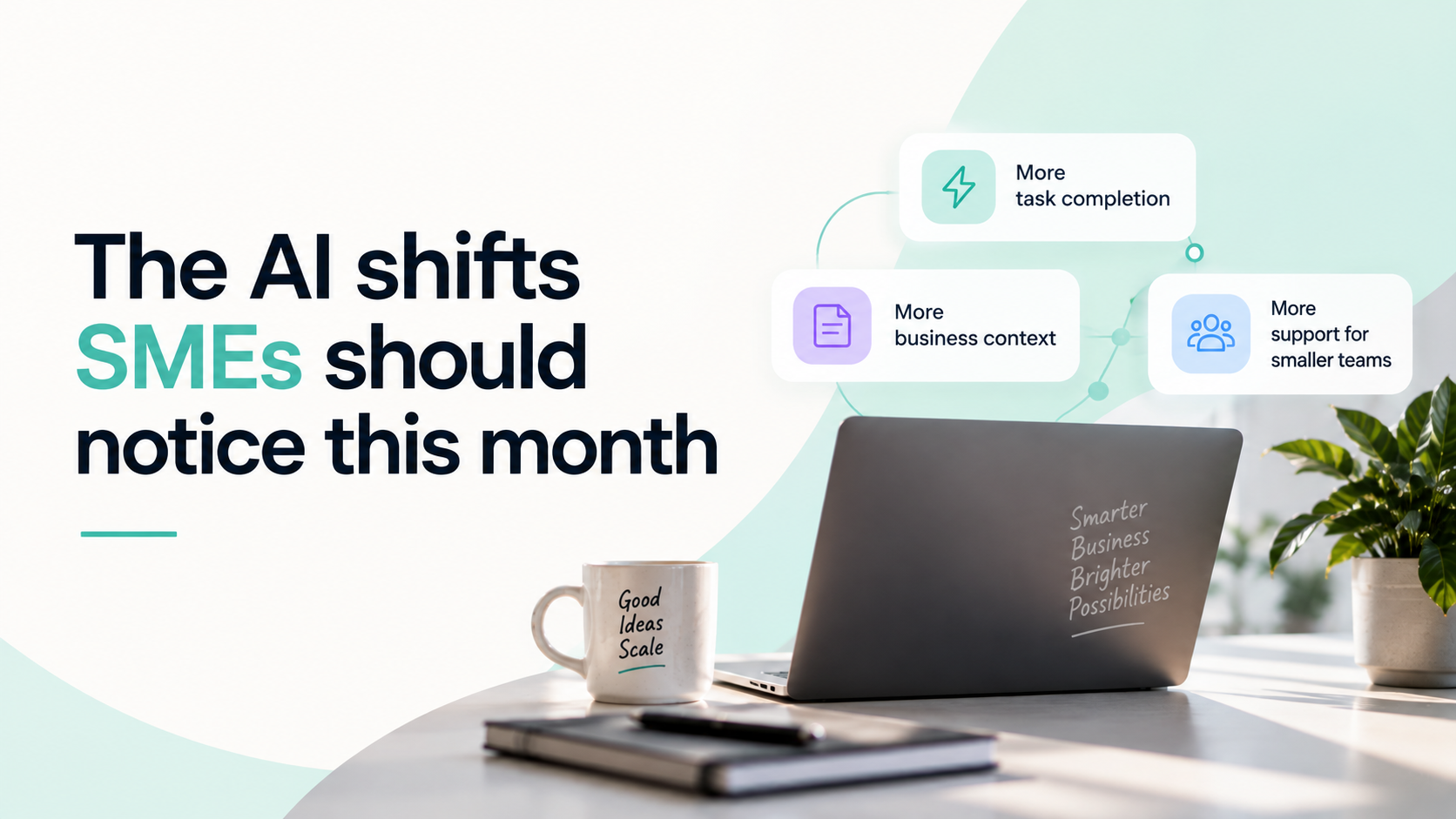
For most small businesses, the most relevant AI changes in the last 30 days are not new headlines about model size. They are the practical moves that make AI easier to put into day-to-day work: more task-completion features, more business context inside consumer tools, and more vendor support aimed at smaller teams. That matters because the decision is no longer whether AI exists, but which parts are ready to save time without creating more admin. ([about.fb.com](https://about.fb.com/news/2026/07/meta-ai-muse-spark-doesnt-just-think-it-acts/?utm_source=openai))
What changed, in plain terms
A useful way to read the recent updates is by the job they help a business do.
Open AI has pushed further into small business support with a dedicated programme, including in-person academies and guidance aimed at owners who need help turning AI into practical work support. It also points to Chat GPT Work as an agent that can handle multi-step tasks end-to-end, which is relevant for SMEs because task hand-offs are where a lot of time is lost. ([openai.com](https://openai.com/index/introducing-chatgpt-small-business-program/?utm_source=openai))
Google, meanwhile, has been adding more business-aware features to Gemini and its wider AI stack. That includes tighter links to Google Business Profile, proactive business notebooks, and broader enterprise-style tools that bring context, governance and workflow support closer to everyday work. For smaller firms already living in Google Workspace, the practical appeal is obvious: less switching between tools and less duplication of information. ([blog.google](https://blog.google/innovation-and-ai/products/gemini-app/gemini-features-for-businesses/?utm_source=openai))
Meta’s latest move is different again. Its new AI features are moving from answering questions to taking action across calendars, email and slides. For a small team, that kind of capability can reduce the number of repetitive coordination tasks that usually sit with the owner or office manager. ([about.fb.com](https://about.fb.com/news/2026/07/meta-ai-muse-spark-doesnt-just-think-it-acts/?utm_source=openai))
Why these changes matter for SMEs
The main shift is not technical sophistication for its own sake. It is that AI is becoming more useful for the “messy middle” of small business work: drafting, summarising, sorting, scheduling and following up.
That is important because SMEs rarely need a lab experiment. They need practical solutions that save time, improve decision-making and create capacity for growth. When AI tools start to handle multi-step work, the opportunity moves from isolated prompts to repeatable processes. ([openai.com](https://openai.com/index/introducing-chatgpt-small-business-program/?utm_source=openai))
There is also a second-order effect. As more platforms build business context into the product, the quality of output depends less on clever prompting and more on whether the business has clear information, consistent processes and sensible boundaries. In other words, better tools expose weaker operating discipline. That is not a problem if you expect it, but it is a risk if you assume the tool will sort everything out on its own. ([blog.google](https://blog.google/innovation-and-ai/products/gemini-app/gemini-features-for-businesses/?utm_source=openai))
The opportunities worth testing first
If you are looking for a sensible starting point, focus on tasks with three qualities:
- They happen often.
- They follow a pattern.
- A poor first draft is acceptable if a human reviews it.
That usually means customer emails, meeting notes, sales follow-up, internal briefings, FAQs, first-pass marketing copy and routine operational summaries.
The recent product updates make those use cases more attractive because the tools are getting better at working with existing business context, not just isolated prompts. Google’s business-profile and notebook additions are built around that idea, while Open AI’s small-business programme and task-oriented agent messaging point in the same direction. ([blog.google](https://blog.google/innovation-and-ai/products/gemini-app/gemini-features-for-businesses/?utm_source=openai))
For SMEs, the right question is not “Can AI do this?” but “Can AI do enough of this to make a measurable difference without creating new risk or review burden?”
The caveats that still matter
Not every AI feature is ready for direct use in a live workflow.
If a task involves customer commitments, pricing, legal wording, regulated advice or sensitive data, it still needs clear review steps. The more an AI tool can act on your behalf, the more important it becomes to define what it is allowed to do, what it can draft, and what must stay with a person. That is especially true where calendar access, email access or document creation are involved. ([about.fb.com](https://about.fb.com/news/2026/07/meta-ai-muse-spark-doesnt-just-think-it-acts/?utm_source=openai))
There is also a practical cost issue. New AI features can look attractive, but if they sit outside your existing stack, or if they duplicate functionality you already pay for, the real cost is not the licence fee. It is the time spent switching, checking and maintaining a second way of working. For SMEs, simplicity usually beats novelty. That is one reason context inside existing tools matters so much. ([blog.google](https://blog.google/innovation-and-ai/products/gemini-app/gemini-features-for-businesses/?utm_source=openai))
A sensible way to respond this month
A low-risk approach is to run a short AI opportunity assessment across three questions:
- Where are we spending repeat time on drafting, summarising or chasing?
- Which of those tasks already live inside the tools we use every day?
- What review step is needed before anything reaches a customer or decision-maker?
That gives you a practical filter for choosing between the latest features, rather than chasing every announcement.
If you already have one or two likely use cases, the next step is not a full transformation programme. It is a focused pilot with clear scope, a named owner and a simple measure of success, such as time saved, faster turnaround or fewer hand-offs. That is the point where AI starts creating measurable value instead of just adding another tool to manage. ([openai.com](https://openai.com/index/introducing-chatgpt-small-business-program/?utm_source=openai))
Examples of practical SME uses
Here are a few bounded examples of where the latest changes may be useful:
- A service business uses AI to turn meeting notes into a client recap and action list, then a person checks tone and accuracy before sending.
- A retailer uses AI-assisted business context to draft responses to common customer questions, while keeping pricing and refund decisions human-led.
- A professional services firm uses an agent-style tool to prepare a first-pass project brief, then reviews scope and assumptions before it reaches delivery.
These are not big-bang use cases. They are small, repeatable improvements that can save time and create capacity across the week.
Conclusion
The last 30 days have brought more evidence that AI is becoming genuinely usable for SMEs, not just interesting to talk about. The strongest signal is the move towards context, action and workflow support inside the tools businesses already use. The practical test now is simple: choose one repetitive process, define the review points, and see whether the tool saves time without creating extra noise.
If you want help identifying the best AI opportunities in your business, start with a conversation or a short assessment before you commit to anything larger.