What Is Artificial Intelligence? A Practical Guide for Business Owners
Understanding Artificial Intelligence (AI) is essential for SMEs aiming to improve operations and grow their business with technology. Yet, many leaders face uncertainty about what AI really is, how it can generate measurable value, and how to implement it without unnecessary complexity. This article provides clear, practical insight into AI concepts, business applications, risks, and the steps necessary to deliver real commercial outcomes. You will also learn how Hally AI approaches AI with a business-first mindset, focusing on practical solutions that support confident adoption and scalable impact.
What Is Artificial Intelligence?
Artificial Intelligence refers to computer systems designed to perform tasks that normally require human intelligence. This includes recognizing patterns, understanding language, making decisions, and learning from data. AI is not a single technology but a broad field that includes several approaches:
- Machine Learning: Algorithms that improve through experience by analysing data and identifying patterns.
- Deep Learning: A subset of machine learning using layered neural networks to model complex relationships.
- Generative AI: Systems capable of creating new content such as text, images, or code from learned data.
- Large Language Models (LLMs): Advanced AI trained on vast amounts of text data to understand and generate natural language effectively.
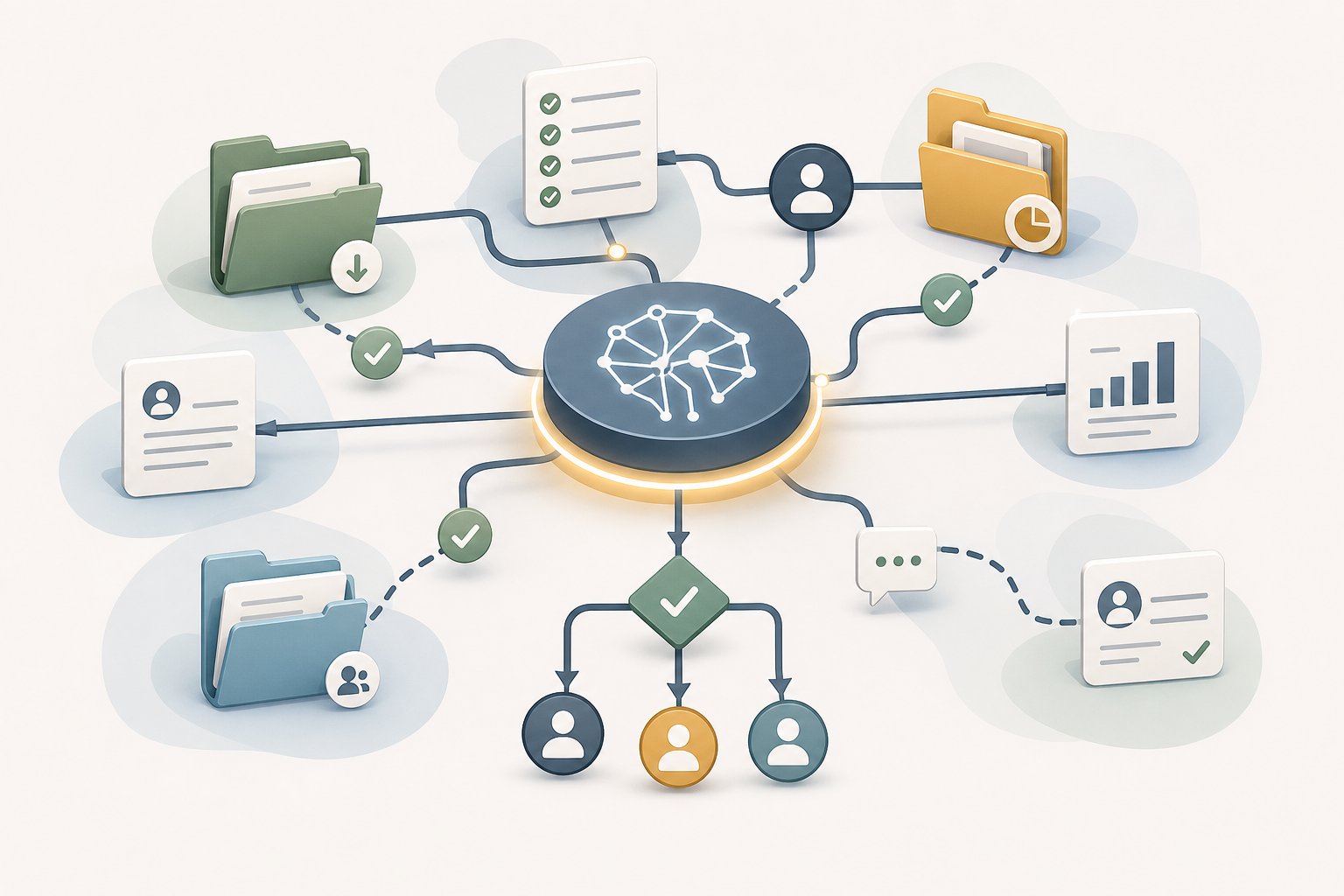
These technologies power AI assistants, custom GPTs, automation tools, and connected AI platforms that can support various business functions.
AI for SMEs: Practical Applications Across Departments
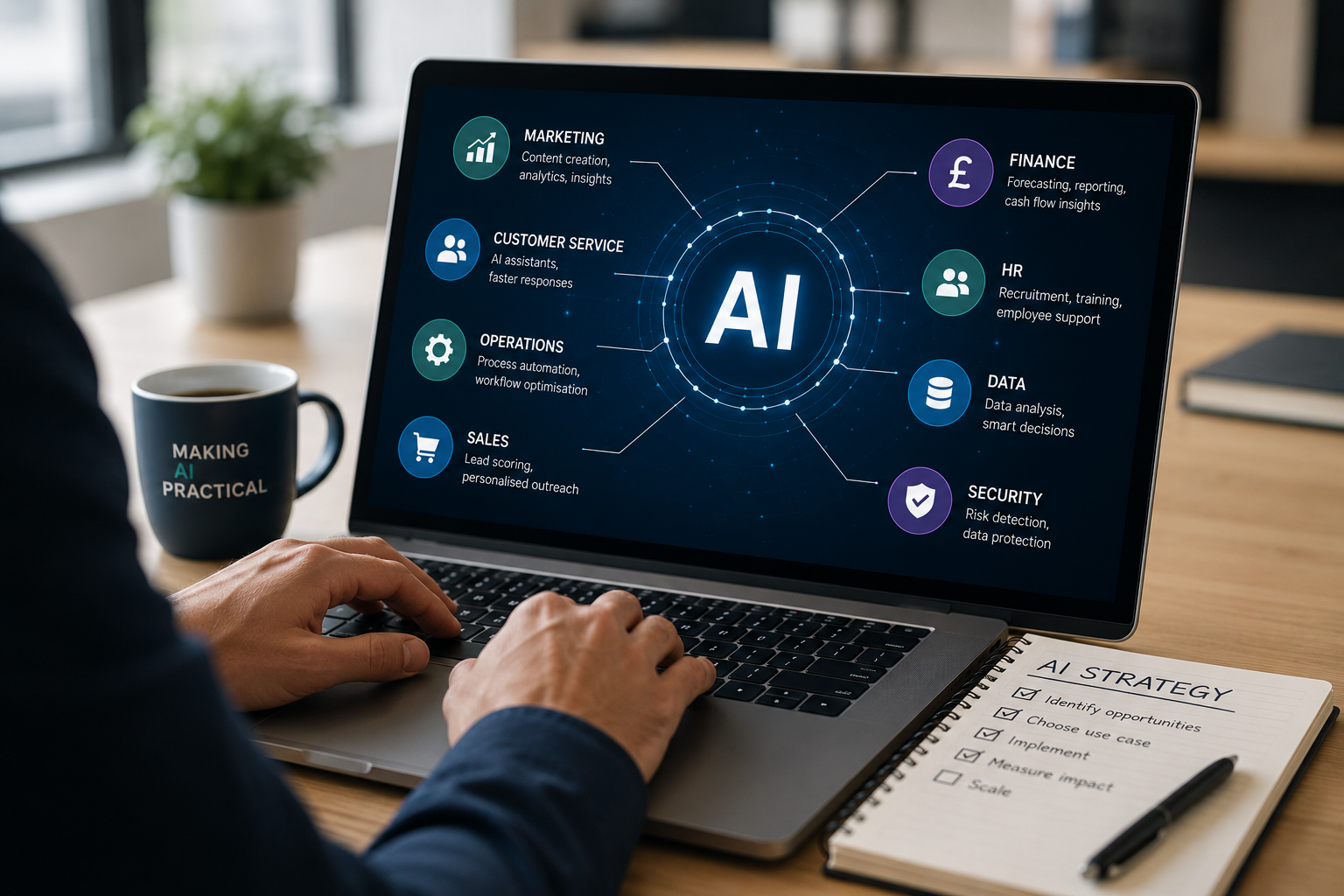
AI is often seen as a tool for large enterprises. However, SMEs stand to gain by identifying specific, practical opportunities that fit their unique workflows and data. Here are examples of AI use cases relevant to common SME departments:
- Finance: Automate invoice processing, reduce manual reporting, and improve cash flow forecasting with instant financial insights.
- Sales & Marketing: Generate personalised content faster, analyse customer data to prioritise leads, and automate routine outreach.
- Customer Service: Use AI assistants to triage queries, provide instant responses, and route complex issues to human agents efficiently.
- Operations: Connect systems and automate repetitive tasks such as inventory management, order fulfilment, and compliance checks.
- HR & Training: Automate candidate screening, create personalised training content, and support team adoption through AI-enabled coaching.
Benefits of AI in Business
The core benefits SMEs can expect go beyond buzzwords to measurable business impact:
- Time Savings: Reduce administrative overhead and manual processes.
- Improved Decision-Making: Access insights faster to guide strategy and daily operations.
- Scalable Solutions: Start small with targeted applications and expand as benefits become clear.
- Enhanced Customer Experience: Respond quicker and personalise interactions.
- Cost Management: Identify inefficiencies and reduce error rates through automation.
Understanding Risks and Governance
Adopting AI requires addressing legitimate concerns about data privacy, security, and bias. SMEs should implement sound governance frameworks to:
- Maintain data security by controlling access and encrypting sensitive information.
- Ensure compliance with regulations such as GDPR.
- Monitor AI outputs for bias or errors that could affect business decisions or customer fairness.
- Provide transparency about AI use to build trust internally and with customers.
Common AI Misconceptions
Many SMEs hesitate to start AI initiatives due to misunderstandings:
- AI is not only for tech companies or large budgets; practical AI can deliver measurable outcomes without complexity. - AI doesn’t replace humans but augments them by automating routine work and enhancing decision support. - Implementing AI is a stepwise process—not an instant overhaul—focused on delivering value from the start.
Implementing AI: A Practical Framework
Successful AI adoption involves a clear, business-first process:
- 1. Discovery and Opportunity Prioritisation: Review processes, interview teams, and identify AI opportunities with clear ROI.
- 2. Build Bespoke Solutions: Develop AI assistants, connected systems, or automation platforms aligned with business needs.
- 3. Train Teams and Support Adoption: Provide training programs and ongoing support to secure confident user adoption.
- 4. Measure Impact and Scale: Conduct quarterly reviews to track measurable outcomes and plan scalable growth.
Hally AI Philosophy: Making AI Practical
At Hally AI, the focus is on practical AI solutions that create measurable commercial outcomes. We help SMEs start small, delivering value early, then scale over time with a clear AI roadmap tailored to your unique business context. Our experienced team combines operational insight with AI expertise to support long-term partnerships, ensuring your investment drives growth, efficiency, and confidence.
Example: Finance Automation at an SME
Consider a mid-sized retail business struggling with manual invoice processing causing delays and errors. By adopting an AI assistant tailored to extract invoice data and automate approvals, the company reduced admin time by 40% and improved cash flow visibility. The solution integrated with existing accounting software, providing instant financial insights and forecasting accuracy. This practical step created measurable impact without disrupting daily operations and enabled the company to scale AI use into inventory management next.
Summary
AI can transform SME operations when approached with clear priorities, practical solutions, and strong partnerships. Understanding what AI is, its applications, risks, and implementation steps helps you move from interest to measurable business impact. Hally AI supports SMEs to navigate AI adoption confidently, focusing on practical first steps, measurable progress, and scalable success.
To discuss how AI can create value in your business, book an AI opportunity call with our team.
Glossary of Technical Terms:
- Artificial Intelligence (AI): Technology enabling machines to perform tasks requiring human intelligence.
- Machine Learning: Algorithms learning from data to improve task performance without being explicitly programmed.
- Deep Learning: Advanced machine learning using multiple layers of neural networks for complex data understanding.
- Generative AI: AI systems that create new content such as text, images, or code.
- Large Language Models (LLMs): Deep learning models trained on extensive text data to understand and generate human-like language.
- AI Assistants: Applications that use AI to support users by automating tasks or providing information.
- Custom GPTs: Tailored AI language models based on GPT architecture designed for specific business needs.
- Automation: Using technology to perform repetitive business processes without manual intervention.
- Connected Systems: Integration of separate software or data sources to enable unified workflows.
- AI Roadmap: A strategic plan outlining AI implementation steps, priorities, and scaling paths. - Opportunity Prioritisation: Evaluating potential AI use cases to focus on those with highest business impact.
- Process Review: Analysing workflows to identify inefficiencies and automation points.
- Adoption: The process of teams embracing and effectively using AI tools and solutions.
- Governance: Frameworks and controls ensuring AI is used ethically, securely, and compliantly.