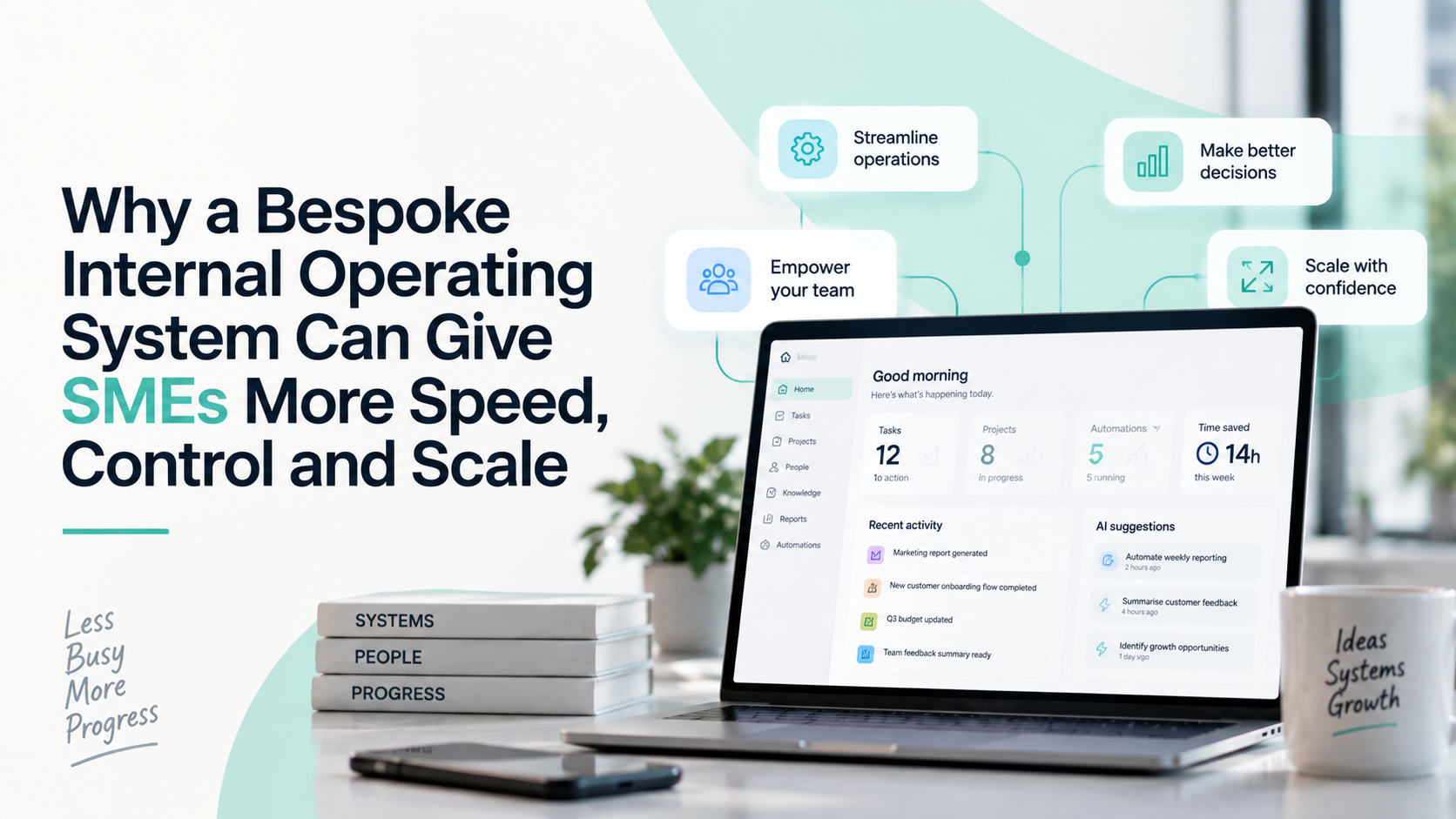

Most businesses know AI matters. Few know where to start. One of the most practical places to begin is with your internal systems: the recurring work, handovers, checks and decisions that keep the business moving every day.
Off-the-shelf software can be useful, but it often asks your team to change how they work in order to fit the tool. Bespoke internal systems take a different approach. They are built around your processes, your approvals, your data and your commercial priorities. When AI is layered into that setup carefully, you can create practical solutions that save time, improve decision-making and create capacity for growth.
That does not mean bespoke AI systems are the right answer everywhere. They can be powerful, but they need clear scope, good data and disciplined implementation. The value comes from solving a real operational problem, not from adding AI for its own sake.
Why bespoke internal systems often work better than generic tools
A generic product is designed for broad use. A bespoke system is designed for the way your business actually operates.
That difference matters when your process is not simple, or when one missed step creates cost, delay or risk. In an SME, internal work often involves several people, several documents and several decisions that do not sit neatly inside a standard package. A bespoke system can bring those pieces together in one place, with AI helping at the points where speed, consistency or judgement are needed most.
For example, AI might help sort incoming requests, extract information from forms, draft a first response, flag unusual cases or summarise information for a manager. The system still belongs to your business rules. AI simply supports the workflow.
That is usually where bespoke solutions earn their keep. They are not trying to replace the business. They are trying to remove friction from it.
Where AI adds the most value inside a business
AI is most useful in internal systems when the work has patterns, but not perfect uniformity.
Good candidates often include tasks such as:
- sorting and triaging enquiries or requests
- pulling information from emails, documents or notes
- drafting standard replies or summaries
- checking data for missing fields or obvious inconsistencies
- helping staff find the right information faster
- supporting decisions with structured summaries rather than raw files
These are not glamorous use cases, but they are the kind that create measurable value because they happen often. If a task is repeated many times a week, even a modest improvement in speed or consistency can free up time.
The key is to look for work that is rule-based in parts and judgement-based in others. AI is rarely the best answer to a fully fixed process. It is far more useful where a human still needs to review, approve or decide, but does not need to start from scratch every time.
The business benefits: time, consistency and capacity
The most immediate benefit of a bespoke AI-enabled internal system is usually time. Less time spent searching, copying, chasing, retyping or reformatting means more time available for higher-value work.
A second benefit is consistency. When a system guides the process, it becomes easier to apply the same standard every time. That matters in areas such as customer service, compliance checks, internal reporting or operational handovers, where variation can create problems later.
A third benefit is capacity. This is not about doing more busywork. It is about creating room for the team to focus on work that actually moves the business forward: sales, service, planning, analysis and relationship building.
For SMEs, that can be the real prize. You do not always need a larger team. Sometimes you need a better system that helps the current team do more with less strain.
The risks: bad scope, poor data and over-automation
The biggest mistake is to treat AI as a shortcut around process design. It is not.
If the underlying workflow is unclear, the system will simply automate confusion. If the data is messy, incomplete or inconsistent, AI will struggle to produce reliable output. If you automate too much too soon, staff can lose confidence in the process and start working around it.
There is also a commercial risk in building something impressive but unnecessary. A bespoke system should solve a specific problem. If the use case is vague, the solution can become expensive to maintain and difficult to adopt.
That is why a good AI opportunity assessment matters before any build begins. The question is not “Where can we use AI?” The better question is “Where can AI create measurable value without introducing unnecessary complexity?”
What a sensible implementation approach looks like
The safest way to build bespoke internal systems is to start small and useful.
A practical approach usually looks like this:
- Identify one process that is time-consuming, repeated and easy to measure.
- Map the current workflow, including who does what and where delays happen.
- Decide which parts should stay human-led and which parts can be supported by AI.
- Build a limited version first, rather than trying to redesign everything at once.
- Test it with real users, then refine the workflow before scaling it.
This keeps the project grounded. It also makes adoption easier because staff can see what the system is meant to do, where it helps, and where human judgement still matters.
For SMEs especially, the best systems tend to be the ones that fit into existing operations instead of asking the whole business to change overnight.
Examples of where bespoke systems can be a strong fit
A bespoke AI-enabled internal system can be useful in many settings, but a few common examples stand out.
An operations team might use one to manage incoming requests, assign work and flag anything that needs escalation. A sales team might use one to summarise lead information, draft follow-up notes and keep the CRM cleaner. A finance team might use one to extract fields from documents, check for missing details and prepare review packs. A leadership team might use one to turn scattered updates into a concise weekly summary for decision-making.
In each case, the value does not come from AI alone. It comes from combining AI with a defined business process. That combination is what makes the system practical rather than theoretical.
The real advantage is control
The strongest argument for bespoke internal systems is control.
You decide the workflow. You decide what data the system uses. You decide where human approval sits. You decide what success looks like. That is a major advantage when your business has specific requirements that generic software does not handle well.
It also gives you a better chance of building something your team will actually use. People tend to adopt systems that reflect how they work, not systems that force them into someone else’s model.
Used well, AI does not remove the need for good operations. It makes good operations easier to scale.
For SMEs that want practical solutions rather than hype, that is where the opportunity sits: in building internal systems that save time, improve decision-making and create capacity for growth without losing control of how the business runs.
Conclusion
Bespoke AI internal systems are not about chasing the latest trend. They are about shaping technology around the business you have, not the business a software vendor assumed you would be.
The upside is clear when the problem is real: faster workflows, fewer manual tasks, better consistency and more room for higher-value work. The caution is equally clear: if the process is unclear or the scope is too broad, the system will not fix the underlying issue.
For SMEs, the best next step is usually a focused conversation about one process, one pain point and one outcome worth improving.