In a business with branches, sites or franchises, the hard part is rarely inventing the process. It is keeping the process the same everywhere once it leaves head office.
A site manager may follow the right steps, but record them differently. One team may close tasks promptly while another leaves updates until the end of the week. Approvals may happen in email on one site and in a spreadsheet on another. Over time, small differences create inconsistent service, uneven reporting and more work for regional leaders.
AI can help with that problem when it is used as a support layer, not as a blunt replacement for local judgement. The useful role is to surface variation, connect information that is already spread across systems, and make it easier for leaders to see where processes are drifting.
Why consistency is so hard across multiple locations
Multi-location businesses usually do not struggle because people are unwilling to follow process. They struggle because the process is being interpreted in different settings, by different teams, with different levels of support.
A head office process often breaks down for practical reasons:
- the same task is logged in more than one system
- local teams use slightly different templates or naming conventions
- managers are busy, so follow-up happens late
- branches work around gaps in the process rather than raising them
- updates live in emails, messages and documents instead of one place
That creates a visibility problem as much as an execution problem. Leaders can see that work is happening, but not always how it is happening. For SME operating systems, that distinction matters. A process is only useful if it is repeatable, trackable and supportable across sites.
AI is useful here because it can read through the variation. It does not need every site to work identically before it starts adding value. It can look for patterns in reports, task updates, approvals and comments, then show where the process is being followed and where it is being improvised.
How AI can surface differences in process performance
The main value of AI for consistency is not speed. It is comparison.
When information is spread across branches, AI can help consolidate it into something leaders can review. That might include:
- pulling site updates into a shared summary
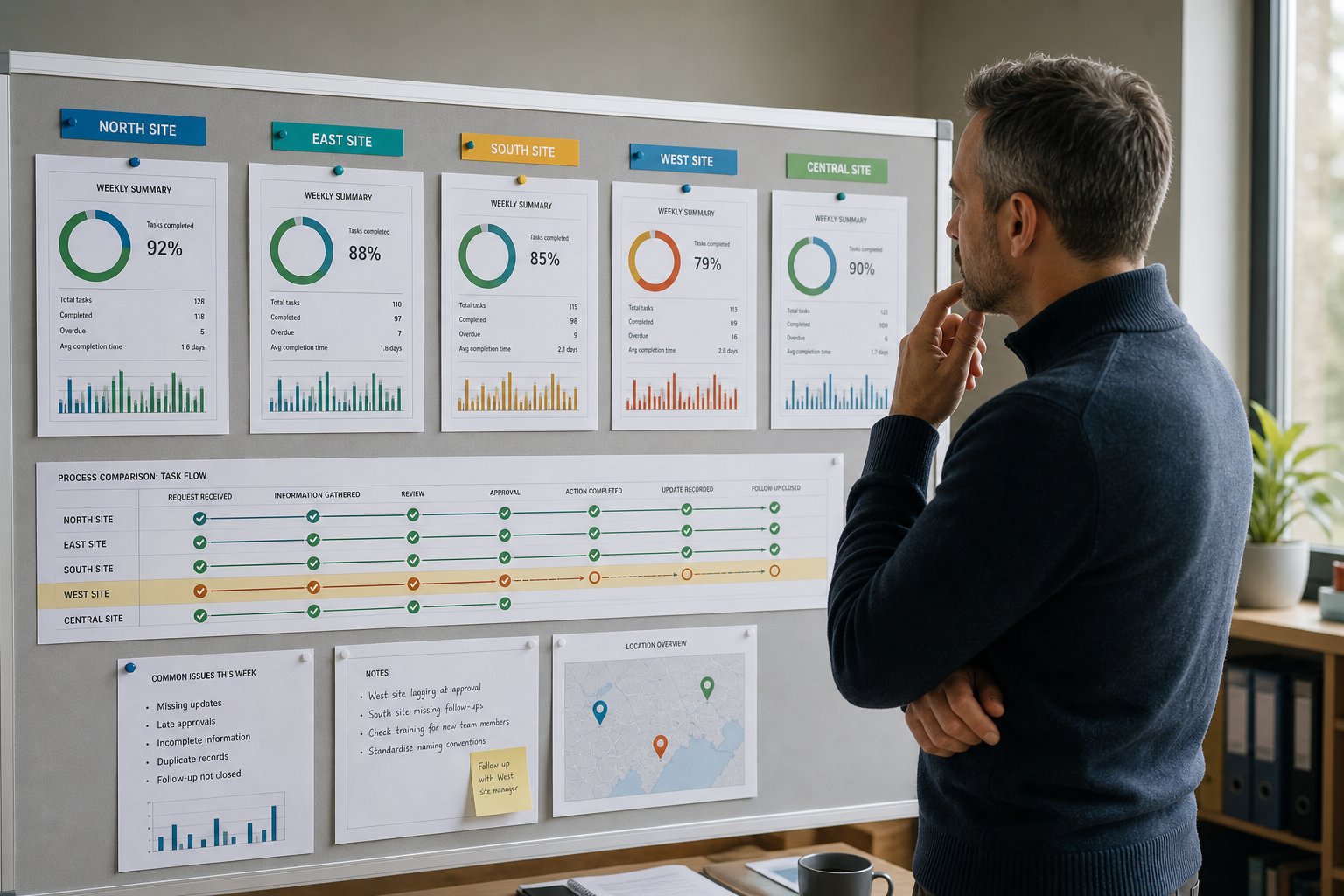
- comparing how tasks are completed across locations
- highlighting missing information before reports are submitted
- spotting repeated delays in one branch or one type of task
- grouping similar issues so managers do not have to read every record manually
Used well, this creates a clearer view of process variation. Not in the abstract, but in the detail that matters: who is completing tasks, which steps are being skipped, where approvals stall and which locations need support.
That can be especially useful for businesses that have grown quickly. A process that worked when there were three sites can become hard to manage at 15. AI can help leadership see whether inconsistency is coming from the process design, the training, the tools or the local workload.
For a business looking at ai consultancy for SMEs, this is often the real starting point: not “what can we automate?”, but “what can we make visible enough to manage properly?”
Practical examples of linking reports, approvals and task updates
AI becomes more useful when it connects the everyday tasks that already shape operations.
A few practical examples:
Reports
If site leaders submit weekly reports in different formats, AI can help standardise the structure. It can extract common fields, flag missing items and summarise differences between locations. That gives regional managers a clearer view without forcing every site to write a long narrative in the same way.
Approvals
If purchase requests, rota changes or exception requests move through email or chat, AI can help identify what needs sign-off, route it to the right person and keep a record of the decision. That reduces the chance of one site following a faster approval route than another.
Task updates
If tasks are updated in separate systems, AI can summarise progress across sites and flag work that has stalled. A manager does not need to open five dashboards to see that one branch is consistently late updating jobs or closing actions.
Internal support requests
If branches ask for help in different ways, AI can categorise the requests, spot recurring issues and direct them to the right internal team. That makes support more consistent and stops the same question being answered differently by different people.
The point is not to create more layers of process. It is to make the existing process easier to follow, easier to check and easier to support.
How leaders use AI to spot issues sooner
For leaders, the biggest gain is earlier warning.
In many multi-location businesses, a problem only becomes visible when a report is late, a customer complaint lands or a KPI moves in the wrong direction. By then, the issue may already have spread across several sites.
AI can help leaders notice signs sooner by flagging patterns such as:
- repeated delays in one location
- a sudden change in task completion rates
- missing updates from one branch team
- inconsistent approval times across similar sites
- recurring exceptions in the same part of the process
That does not replace local management. It supports it. The manager still needs to ask why the pattern is happening. But AI can cut down the time between the first variation and the moment someone senior notices it.
This matters because inconsistency often hides in plain sight. A site may still be “fine” overall while one step in the process is slipping every week. If leaders only look at end results, they miss the operational cause. If they can see the process itself, they can support the team before the issue becomes a wider problem.
What to pilot first when sites operate differently
The best first pilot is usually the one that is simple to measure and closely tied to an existing pain point.
For multi-location businesses, that often means starting with one of these:
- a recurring report that is completed by every site
- an approval process that regularly slows down
- a task update workflow that lacks visibility
- an internal support process with too many manual handovers
The pilot should meet three tests:
- It affects multiple locations.
If the issue only exists in one branch, it is probably a local fix.
- The process is already familiar.
AI is easier to adopt when teams recognise the task and can see how the support fits into their current work.
- The result is easy to measure.
A good first win might be fewer missing updates, faster approvals, fewer manual chases or a clearer comparison between sites.
That last point matters. If the pilot cannot be measured, it will be hard to show whether the support is creating measurable value. For SMEs, the goal is not AI for its own sake. It is practical solutions that save time, improve decision-making and create capacity for growth.
A focused pilot also helps surface the real constraint. Sometimes the issue is not the technology. It is that each site has adapted the process differently, and the business has never written down the common standard clearly enough.
Making standardisation easier to support
AI will not make every branch work the same way on its own. It will not fix unclear ownership, poor training or a process that is too complicated to run consistently.
What it can do is make variation easier to see, easier to compare and easier to manage. That is often the missing piece in multi-location businesses. Leaders do not need more noise. They need a clearer view of where the process is working, where it is drifting and where teams need support.
If you are looking at sme operating systems and trying to bring more consistency across sites, the best place to start is usually not with a grand transformation. Start with one process, one pain point and one measurable outcome.
If that is the stage you are at, a practical AI opportunity assessment can help identify where AI would genuinely improve oversight and where a simpler process change would do the job.