Manual finance reporting tends to break down in the same places: data is copied between systems, numbers are checked in different versions of the same spreadsheet, and the story behind the figures sits in someone’s inbox or head. For SME finance teams, the problem is rarely a lack of effort. It is usually a lack of connected information.
That is where AI can help in a practical way. Used well, it should not add another layer of complexity. It should reduce repetitive admin, surface issues earlier, and bring financial data and operational context into the same view so directors can make decisions with more confidence.
Where finance teams lose time
Most time drains in SME finance are predictable.
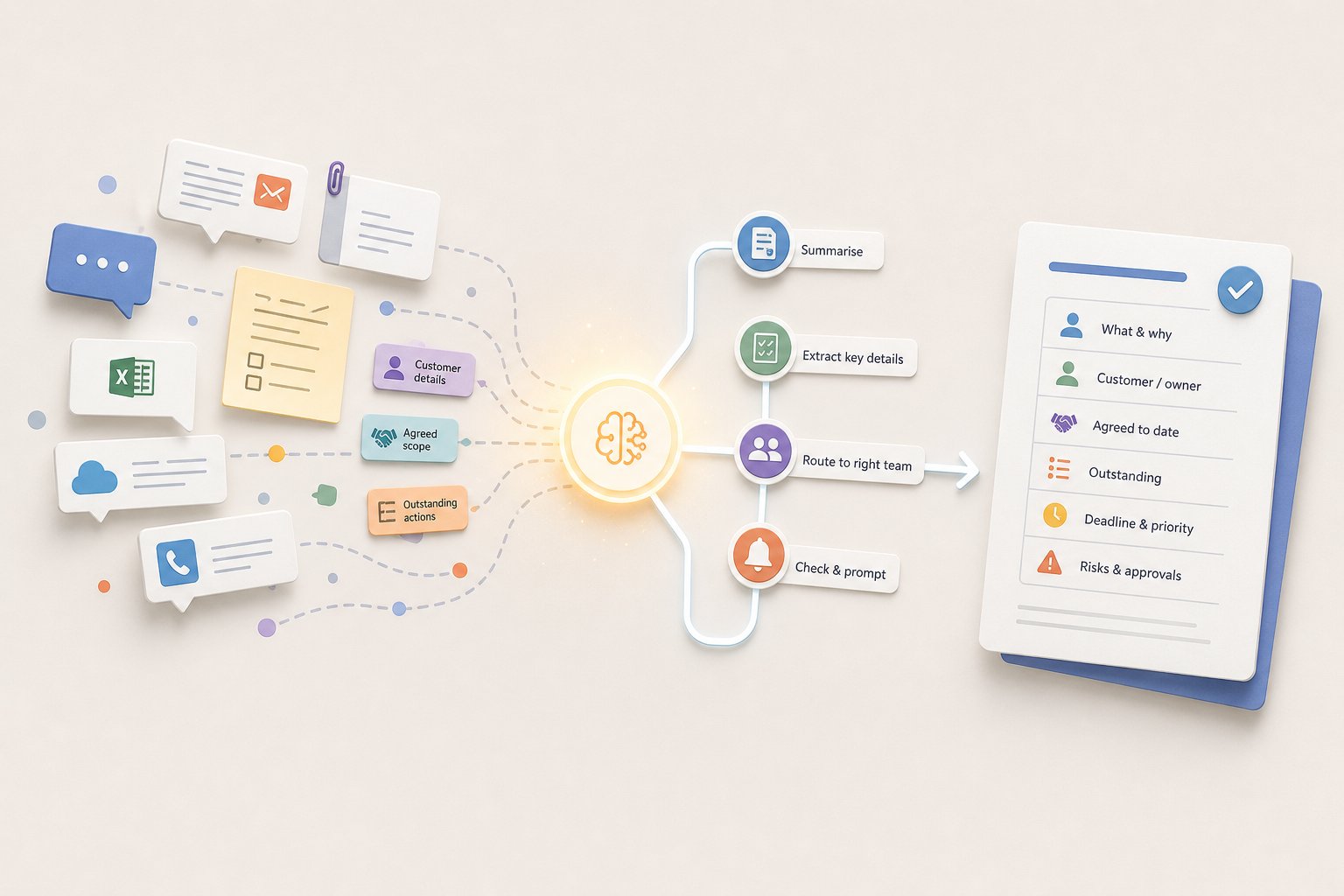
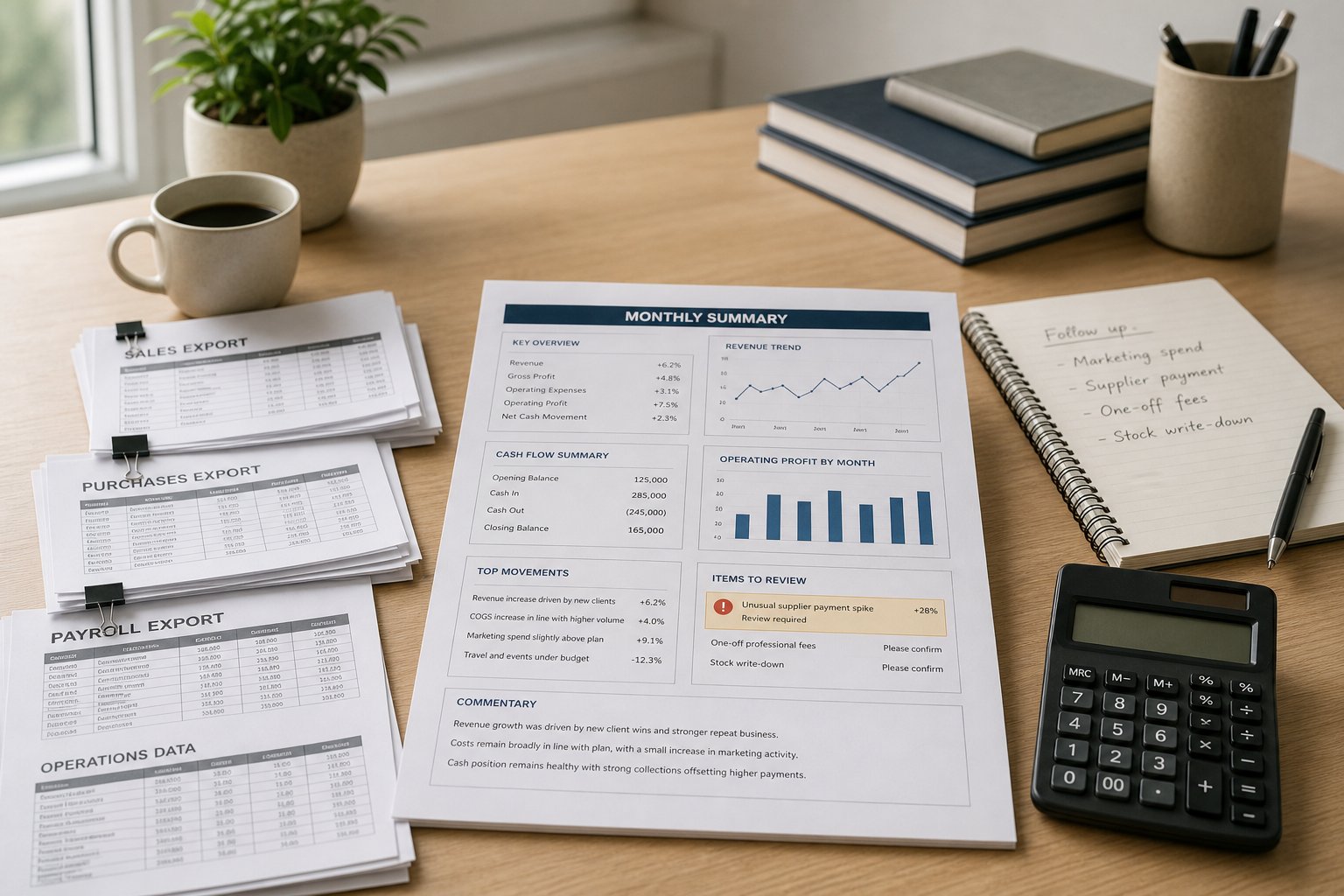
Data often arrives from sales, operations, purchasing and payroll in different formats, at different times, and with different levels of detail. Someone then has to reconcile it, clean it, check it, and explain it. That work is valuable, but it is also repetitive.
The hidden cost is not just time spent building reports. It is the time lost when reporting becomes a manual chase:
- waiting for missing inputs
- reformatting exports
- matching codes across systems
- checking for duplicates and exceptions
- updating the same figures for weekly, monthly and board reporting
When teams rely on spreadsheets alone, they often spend more energy preparing the numbers than using them. AI is useful here only if it removes steps from the process rather than creating new ones.
How AI can support reporting, categorisation and follow-up
A sensible first use of AI in finance is not forecasting the future. It is improving the quality and speed of routine reporting.
AI can help by:
- categorising transactions more consistently
- flagging unclear or unusual entries for review
- summarising report changes in plain language
- drafting follow-up questions for budget holders
- highlighting items that need human approval
That matters because finance teams do not need AI to make decisions for them. They need support in the parts of the workflow that slow them down.
For example, if month-end reporting always involves chasing departmental explanations, AI can help pre-sort the questions. It can point to variances, group similar issues, and produce a first pass on what needs checking. The finance team still reviews the result, but the starting point is cleaner.
This kind of support is especially useful in SMEs because the team is usually small. A tool that saves a few hours every reporting cycle can create real capacity without changing the whole finance function.
Connecting financial data to sales and operations inputs
The best reporting is not just accurate. It also explains why the numbers changed.
That is why finance teams gain more value when financial data is connected to sales and operations inputs. Revenue trends mean more when they sit alongside pipeline data, order volumes, stock movements, staffing levels, project milestones or production delays.
AI is useful here because it can help combine information that would otherwise sit in separate places. It can surface patterns across datasets and present them in a way that supports decision-making.
For example:
- a sales dip may be easier to interpret if it lines up with a drop in qualified leads
- an increase in costs may make sense if it follows higher volumes or supplier changes
- cash flow pressure may become clearer when payment terms, invoice timing and operational spend are viewed together
This is where the real value of ai for smes often appears. Not in replacing spreadsheets altogether, but in reducing the distance between the finance numbers and the operational reasons behind them.
That gives directors a better basis for action. Instead of asking only, “What happened?”, they can ask, “What drove it, and what do we need to change?”
Using AI to highlight anomalies and risks
AI is particularly helpful when the question is not about averages, but about exceptions.
Finance teams need to know when something looks wrong, unexpected or out of pattern. That might be a duplicate invoice, an unusual spend spike, a margin drop, a missed payment trend or a forecast that no longer fits current trading conditions.
AI can support this by scanning for outliers and prompting review. It does not need to be perfect to be useful. In fact, its value often lies in narrowing attention to the small number of items that deserve human checking.
That said, anomaly detection needs careful setup. If the underlying data is messy, the tool will flag too much noise. If the thresholds are too tight, the team will spend time reviewing harmless changes. If they are too loose, the real issues may be missed.
The practical approach is to use AI as a filter, not a judge. Finance still owns the call. The technology just helps the team reach the right questions faster.
How to keep the first use case simple and useful
The safest way to start is to improve one repeatable process, not the whole finance function.
A good first use case usually has four qualities:
- it happens often
- the inputs are already available
- the output is easy to check
- the benefit is measurable in time, accuracy or clarity
For many SMEs, that might be weekly management reporting, month-end variance commentary, aged debt review, supplier spend analysis or cash flow tracking. The right choice depends on where the team loses the most time and where better visibility would change decisions.
Keep the scope tight. Define the data sources clearly. Decide who reviews outputs. Set a simple measure of success, such as fewer manual touches, faster reporting, or better-quality exceptions. That keeps the project grounded and reduces the risk of building something clever that nobody uses.
This is also why finance is often the best place to start with AI. The work is structured, the value can be measured, and the improvement is easier to prove than in more loosely defined processes.
A practical example of the benefit
Imagine a finance team that currently spends two days each month pulling together management reporting.
The process includes export files from accounting software, sales data from a CRM, and operational figures from a separate spreadsheet owned by the operations team. Someone then checks the numbers, chases explanations and rewrites the commentary before it goes to the directors.
A practical AI-supported workflow could change that in stages:
- data is brought together in a consistent format
- routine categorisation is handled automatically
- unusual movements are flagged for review
- commentary is drafted from the underlying changes
- the finance lead checks the output and adds context before sharing
The result is not a fully automated finance function. It is a faster, cleaner process with fewer manual handoffs and better visibility into what is driving the figures.
Better finance visibility starts with one process
AI for finance teams in SMEs works best when it removes friction from existing reporting, not when it tries to replace the team’s judgement. The goal is better visibility, less admin and stronger decision support.
If your finance team is spending too much time moving numbers around, the right first step is to identify one repeatable reporting process that could be made simpler, quicker and more reliable. From there, it becomes easier to see where AI can create measurable value without adding unnecessary complexity.