Manufacturing businesses often have the right data in the wrong places. Production systems know what has been made, stock systems know what is on the shelf, and admin systems hold order, customer and scheduling details. The problem is not a lack of information. It is that the information arrives in separate streams, so people spend time reconciling versions instead of acting on what is happening now.
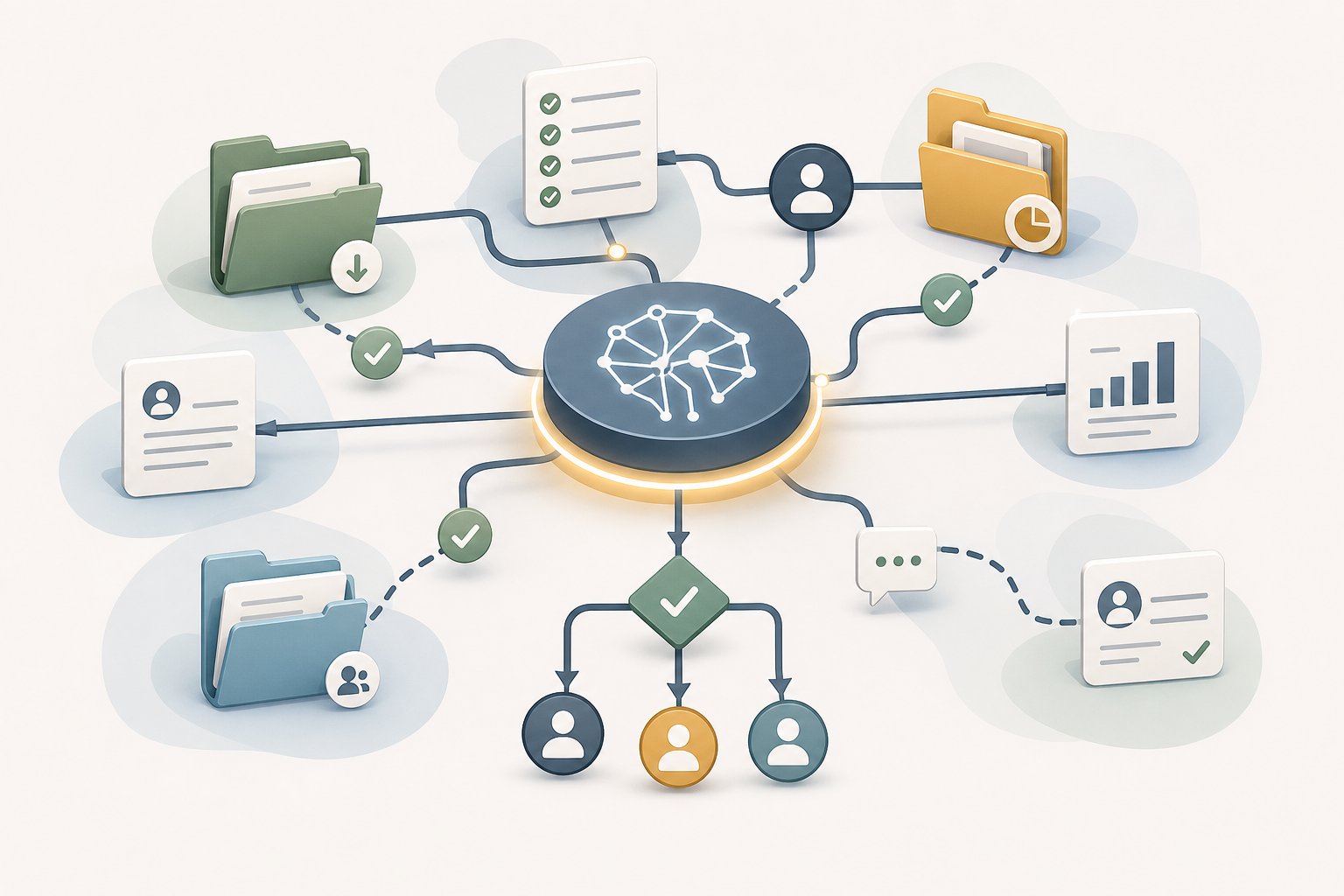
AI can sit above those systems as an intelligence layer. Used well, it does not replace the tools you already rely on. It connects them, highlights what needs attention and gives managers a clearer view of the business. For SMEs, that can improve decision-making without forcing a wholesale systems overhaul.
The real cost of disconnected production and admin data
When production and office data live separately, small gaps turn into daily friction. A planner may be working from yesterday’s stock position while the warehouse is dealing with a different number. Sales may promise a lead time that no longer fits current capacity. Finance may see an order as live before operations has confirmed materials are available.
These are not just admin irritations. They create avoidable waste:
- staff spend time checking, chasing and re-entering the same information
- stock is over-ordered or held longer than needed
- production plans are built on incomplete signals
- customer updates are slower and less reliable
- managers react late because the issue only becomes visible after it has affected output
For many SMEs, the hidden cost is not the system itself but the manual effort needed to make sense of it. That is where AI has a practical role. It can pull signals together, surface exceptions and reduce the need for people to do the joining work by hand.
Where AI adds value as a visibility layer
The best use of AI in manufacturing is usually not a dramatic transformation project. It is a layer that improves visibility across the business by connecting existing information.
That can happen in a few ways:
Bringing together signals from different systems
AI can review data from production logs, stock records, job sheets, purchase orders and order management to spot mismatches or missing updates. Instead of asking people to look across multiple screens and spreadsheets, it can present one operational view.
Turning raw activity into usable prompts
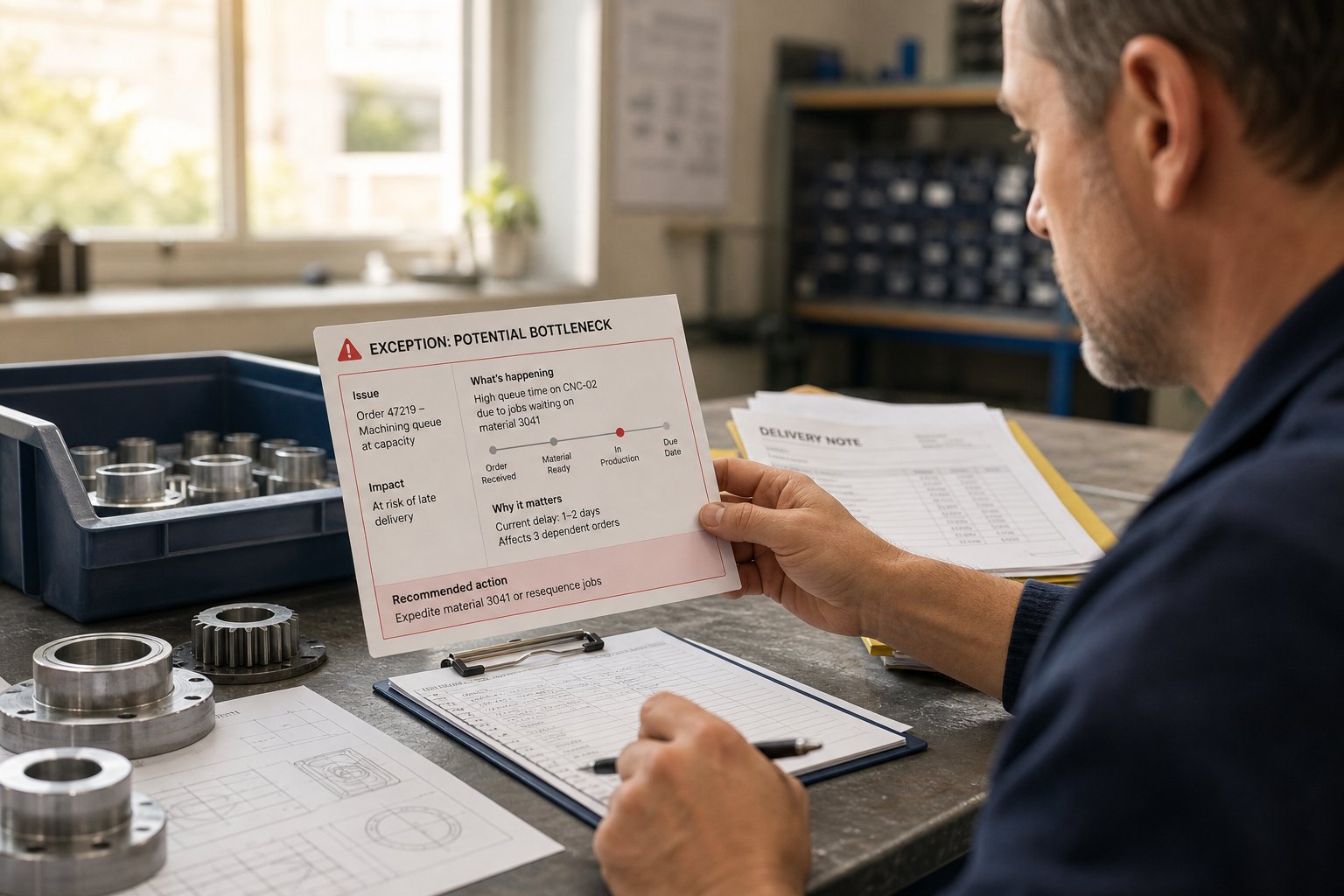
A lot of manufacturing data is technically available but not immediately useful. AI can flag when a job is running behind, when stock cover is slipping or when an order is waiting on a missing input. The point is not perfect prediction. It is earlier attention.
Supporting consistent decisions
If one team is working from live production data and another is working from a spreadsheet copy, decisions drift. An AI layer can help make sure the same underlying information informs planning, customer communication and admin processing.
For SMEs using a mix of legacy software, spreadsheets and newer cloud tools, this is often the most practical entry point into AI for SMEs. It works with the sme operating systems already in place rather than demanding everything be replaced first.
Practical examples in stock, planning and order status
The most useful AI opportunities are tied to real operational pain points. In manufacturing, three areas usually stand out.
Stock visibility
AI can combine stock balances, supplier lead times, open purchase orders and planned jobs to show where shortages are likely to appear. That gives operations a better chance of acting before a line stops or a job is delayed.
It also helps where stock exists physically but not digitally, or where the digital record lags behind reality. AI cannot fix poor stock discipline on its own, but it can make inconsistencies easier to spot.
Production planning
Planning often breaks down when demand changes faster than the plan. AI can compare order intake, machine availability, labour capacity and material status to highlight where the current schedule is likely to slip.
That does not mean handing planning over to a black box. A better use case is a decision-support layer that shows which jobs are most at risk, which have dependencies and where a reshuffle may reduce disruption.
Order status and customer updates
Admin teams spend time answering a simple question in different forms: where is this order up to?
If order status sits across multiple systems, AI can assemble a more reliable answer from production, dispatch and stock signals. That can reduce manual chasing and improve the quality of customer communication. It also gives sales and service teams a more accurate picture before they promise dates externally.
How AI helps spot bottlenecks earlier
Most bottlenecks are visible in hindsight. The job is to notice them while there is still time to intervene.
AI can help by monitoring patterns that are easy to miss when teams are busy:
- a job that repeatedly sits in one stage longer than expected
- a material that keeps arriving after the planned start date
- a machine or team that appears overcommitted before the schedule breaks
- order changes that are not reflected quickly enough in production priorities
- repeated hand-offs between departments that slow things down
The value is not in replacing experienced managers. It is in giving them earlier warning. In a busy operation, that can mean the difference between a small adjustment and a missed delivery.
The caveat is important: AI needs clear, reliable inputs. If processes are inconsistent, the output will reflect that. For that reason, the most effective projects usually start with a defined process, a known pain point and a measurable target.
A sensible first pilot for a manufacturing SME
A good first pilot should be narrow enough to manage and specific enough to prove value. For many SMEs, a strong starting point is order status, stock visibility or one recurring planning issue.
A sensible pilot usually has five parts:
- Choose one pain point
Pick a problem that already costs time or causes disruption, such as delayed stock updates or late production changes.
- Map the data sources
Identify where the information lives, who uses it and how often it changes.
- Define the decision you want to improve
Be clear whether the goal is earlier intervention, fewer manual checks, better customer updates or more reliable scheduling.
- Keep the scope small
Start with one site, one product line, one process or one team rather than the whole business.
- Measure the outcome in operational terms
Look for practical indicators such as fewer manual reconciliations, faster status checks, earlier flagging of delays or less time spent chasing information.
That approach keeps the project grounded. It also makes it easier to learn what the business actually needs before expanding.
Making AI work with the systems you already have
Manufacturers do not need to rip out their current systems to get value from AI. In many cases, the better move is to connect what is already there, identify the gap between data and decision, and use AI to close it in a controlled way.
That is the commercial case for an intelligence layer: not more technology for its own sake, but clearer visibility, better planning and less waste. For SMEs, the priority is to start with one specific operational issue, prove the benefit and build from there.
If you are looking at AI for SMEs and want a practical starting point, the right first step is usually a conversation or an AI opportunity assessment focused on one problem your team already feels every week.