
For many owners, AI for local businesses sounds like something built for larger firms with bigger budgets, more staff and a dedicated tech team. In practice, the opposite can be true. Small firms often feel the pressure most acutely: too many admin tasks, too much time spent on repeat work, and too little capacity to chase growth. Used well, AI can help improve efficiency and profitability without changing the basic character of the business.
That does not mean every local business should rush into automation. The right approach is to look for practical, low-risk tasks where AI can save time, support decision-making or free up capacity. For a local builder, accountant, nursery or trades firm, that often starts with work that is repetitive, text-heavy or easy to standardise.
Why local businesses should take AI seriously
The biggest mistake is assuming AI only matters when you are trying to scale quickly. Local businesses usually have a different challenge: they need to stay responsive, keep overheads under control and make every hour count. AI can help in those areas because it is good at handling routine, structured work that takes up people’s time.
That includes tasks such as drafting emails, summarising notes, sorting enquiries, preparing first drafts of documents, creating reminders, and helping staff find information faster. None of that replaces the judgement, experience or relationship-led work that makes a local business valuable. It simply removes some of the friction around it.
The commercial case is straightforward. If a task currently eats up owner time or admin time, and the task can be repeated with a clear process, there is probably an AI opportunity worth testing. The point is not to use AI everywhere. The point is to use it where it creates measurable value.
Where AI fits in day-to-day operations
Most useful AI use cases for small businesses fall into a few practical categories.
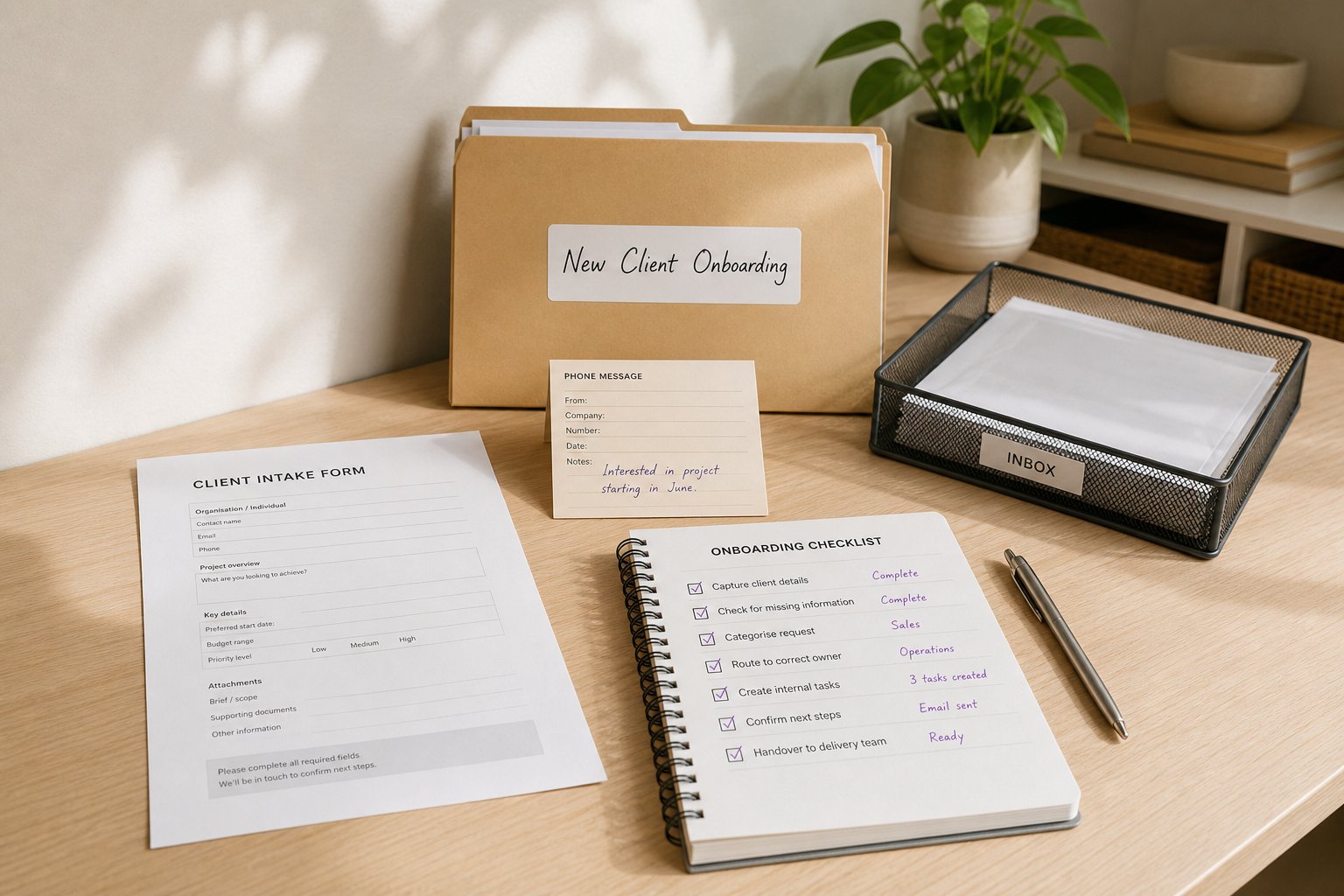
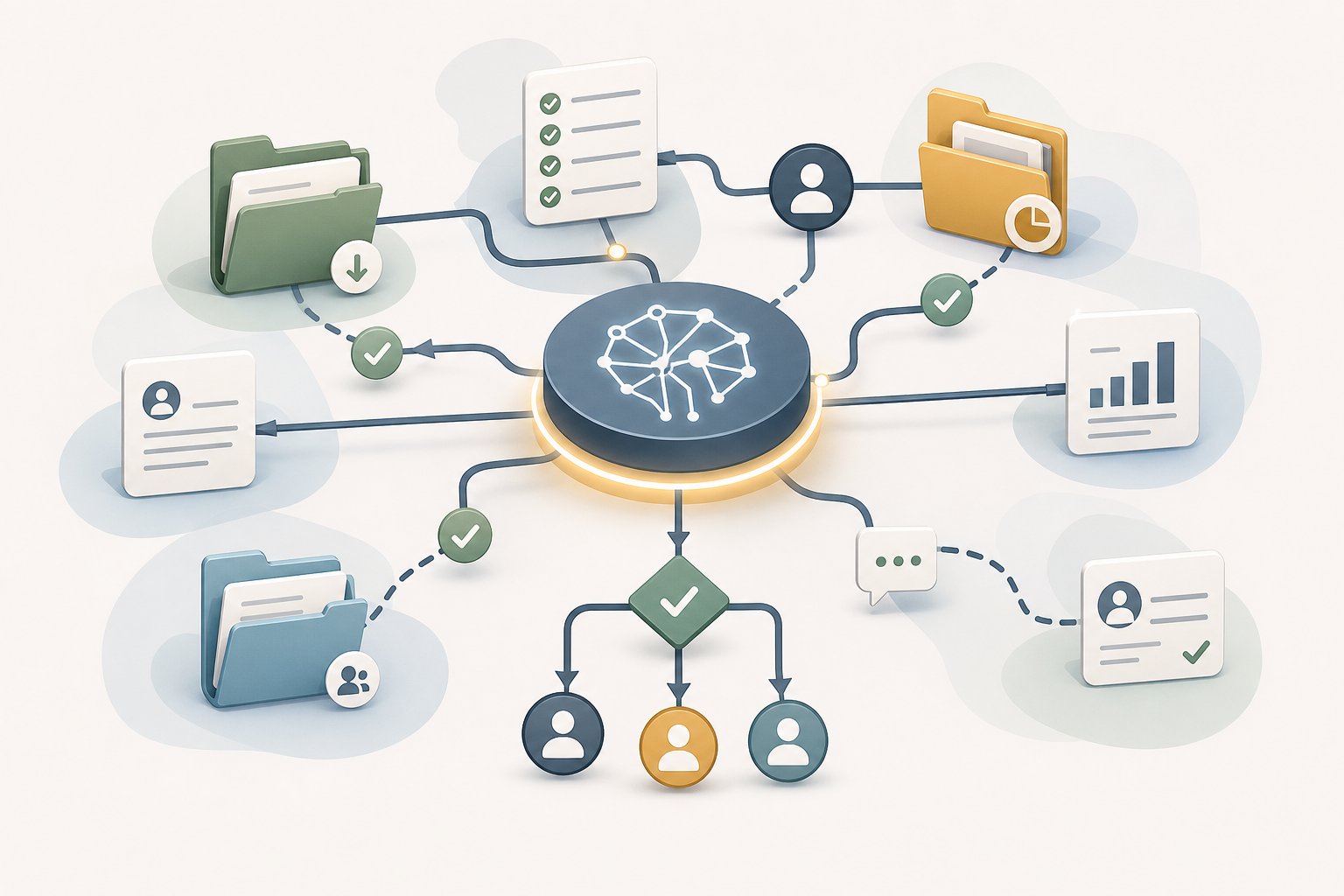
First, there is administration. AI can help triage incoming emails, draft replies, summarise long threads and extract actions from meeting notes. For a small team, that can reduce the stop-start effect of constantly switching between client work and admin.
Second, there is content and communication. AI can help produce first drafts of quotes, customer follow-ups, service reminders, appointment confirmations, social posts or FAQ pages. The human team still needs to review and adjust tone, accuracy and context, but starting from a draft is often faster than starting from a blank page.
Third, there is decision support. AI can help spot patterns in basic business information, such as which services are asked about most often, which jobs take longest to close, or which enquiries need faster follow-up. Used carefully, that kind of support can improve decision-making without requiring a complex data project.
Fourth, there is customer service. A simple AI-assisted assistant on a website can answer common questions, capture lead details or direct people to the right next step outside business hours. For a local firm, that can be useful if missed enquiries are a problem, but it only works well when the answers are accurate and maintained.
Practical examples for local builders, accountants and nurseries
The best way to judge AI is to look at the work already happening in a business.
- For local builders, AI can help with quoting, customer communication and scheduling. A builder might use it to turn site notes into a clearer estimate, draft a follow-up message after a visit, or create a job summary for the team. It can also help standardise responses to common questions about timelines, materials and next steps. That is not about replacing craftsmanship or site knowledge. It is about reducing the admin around it.
- For local accountants, the value often sits in document handling and client communication. AI can help draft meeting summaries, organise client questions, create templates for common requests and support the first pass of correspondence. It may also help review large volumes of internal notes so the team can find what they need more quickly. The caveat is important: any financial or compliance-related output needs proper human review. AI can support the process, but it should not be left to make the judgement call.
- For nurseries, AI can be useful in communication, planning and documentation. It might help write clearer parent updates, summarise observations, create activity ideas or manage routine reminders. It can also support staff with policies, scheduling notes and internal handovers. The gain here is often not dramatic transformation. It is a calmer, more consistent admin process that gives staff more time with children and families.
- For other local businesses, the pattern is similar. A salon might use AI to manage booking enquiries and reminders. A local estate agent might use it for listing descriptions and follow-up emails. A small manufacturer might use it to draft order updates or internal process notes. The specific use case matters less than the principle: start where repetitive work is costing time.
What to avoid if you want real business value
AI becomes expensive when it is introduced without a clear purpose. A tool that sounds impressive but solves no actual problem is just another subscription.
The most common mistake is trying to automate a broken process. If a business has unclear handovers, inconsistent customer records or weak internal communication, AI will not fix that on its own. It may even make the problem harder to see. Get the process clear first, then apply the tool.
Another risk is over-automation. Local businesses often rely on trust, tone and personal relationships. If customer messages become generic, or if staff start treating AI output as finished work, the business can lose what makes it feel local in the first place. AI should support the relationship, not flatten it.
There is also a governance issue. Anything involving customer data, financial information, children’s details or sensitive operational notes needs careful handling. A practical AI approach should define what data can be used, who reviews outputs, and where human approval is required. That is not red tape. It is basic control.
How to choose the right first step
The best starting point is usually a small, contained AI opportunity rather than a full transformation project.
A sensible first step is to look for a process that is frequent, repetitive and easy to check. Good candidates usually meet three tests:
- They take time every week.
- They follow a repeatable pattern.
- The output can be reviewed by a person before it goes out.
That might be drafting standard replies, summarising calls, creating job notes, or organising internal information. The aim is to test whether AI can save time or improve consistency without creating risk.
From there, a local business can assess whether the tool is genuinely useful. If staff ignore it, the process is too awkward. If it creates errors, the workflow needs tighter review. If it saves time and improves consistency, there is probably a broader opportunity worth exploring.
This is where a practical AI opportunity assessment can help. The right assessment does not start with technology. It starts with the business, the bottlenecks and the work that creates the most friction. From there, the solution design and implementation can stay focused on measurable value.
AI works best when it supports people, not replaces them
For local businesses, AI is not about chasing novelty. It is about making the existing business run better. That might mean fewer admin hours, faster responses, clearer communication or better use of owner time.
The firms that benefit most are usually not the ones with the biggest budgets. They are the ones that know where time gets wasted and are willing to test practical solutions in a controlled way. If you run a local business and want to improve efficiency without overcomplicating the operation, the right question is not whether AI matters. It is where it could save time and create capacity in your business today.
If you want to explore that in a sensible, low-pressure way, start with a conversation about your current workflows and the tasks that slow your team down most.