Most SME teams have more AI ideas than time, budget or internal bandwidth. The hard part is not finding possibilities. It is choosing the first one that is small enough to deliver, useful enough to matter and clear enough to prove value without turning into a long internal rethink.
For an internal systems project, the best first AI use case is usually a workflow problem with visible friction, usable data and a measurable outcome. That combination gives you a practical starting point for ai for smes: enough structure to implement well, enough value to justify the effort and enough clarity to learn from the result.
Why many AI ideas never get started
AI projects often stall because the idea is framed too broadly. “Improve operations” or “make better use of our data” sounds ambitious, but it does not tell anyone what to build, who will use it or how success will be judged.
In SME internal systems work, that vagueness creates three problems. First, the team cannot estimate effort because the workflow is undefined. Second, the data question gets pushed aside until late in the process. Third, the project has no agreed finish line, so it starts to look risky before it begins.
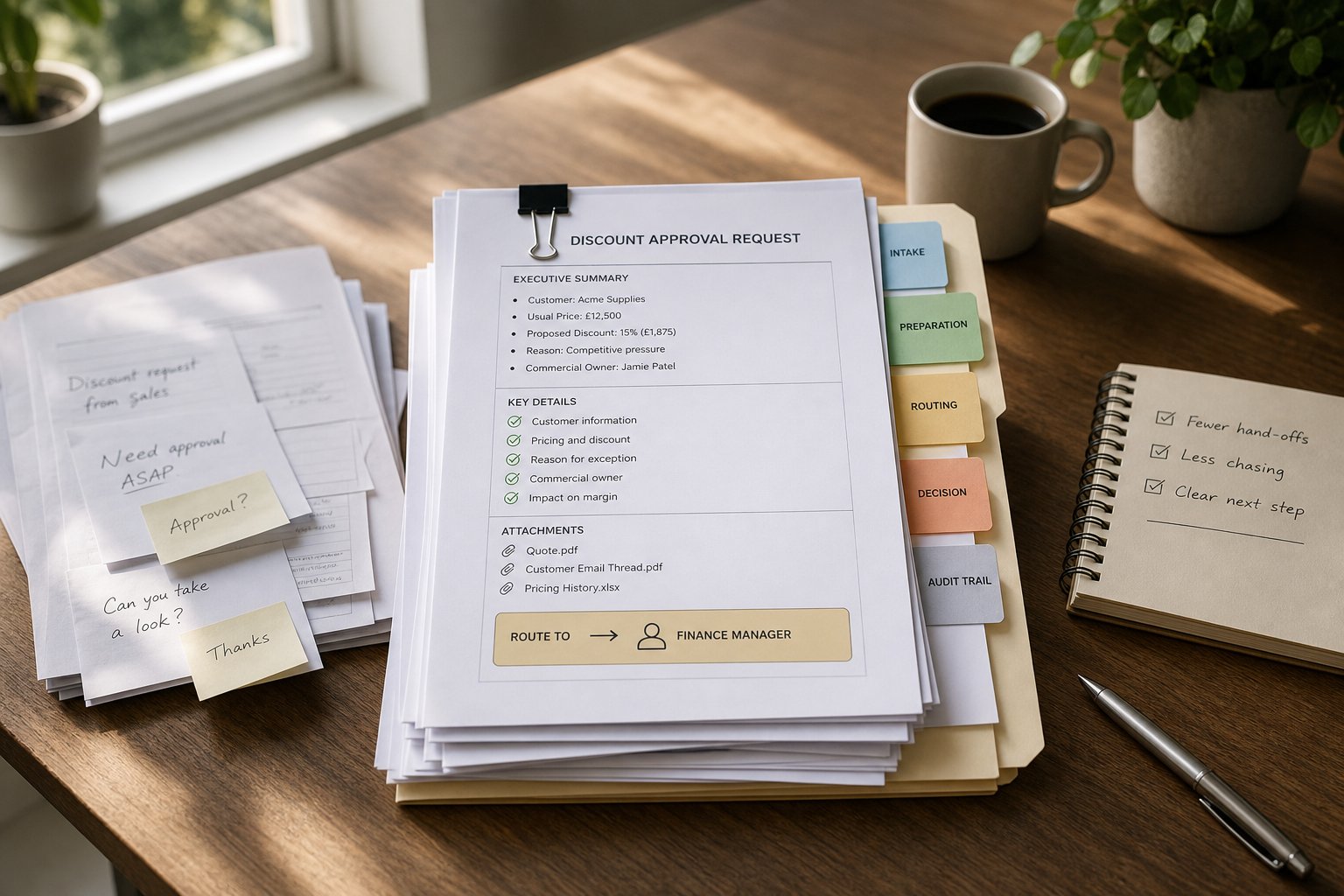
A better first use case is narrow enough to describe in one sentence. For example, reducing time spent triaging internal requests, extracting information from repeat documents or flagging exceptions in a routine workflow. Those are operational problems, not abstract AI ambitions.
That is also why an ai consultancy for smes should start with prioritisation rather than technology. If the use case is not anchored in a real process, the conversation tends to drift towards capabilities instead of outcomes.
The three signs a use case is worth exploring
A good first candidate usually shows up in one of three ways.
1. People keep repeating the same manual steps
If staff are copying data between systems, checking the same information in multiple places or answering the same internal questions over and over, the workflow may be a strong AI candidate. The repetition matters because it creates a clear place where automation or decision support could save time.
2. The result affects cost, speed or decision quality
Not every repetitive task is worth changing. The stronger candidates are the ones where a better outcome is easy to recognise. That might mean faster turnaround, fewer errors, less rework or better prioritisation. If the business cannot explain what improves, the use case is probably too loose.
3. The process already follows a pattern
AI is easier to apply where the work has rules, examples or a common structure, even if the inputs vary. A process that changes randomly from case to case is harder to standardise. A process that follows the same logic again and again is easier to support with a practical solution.
A useful test is this. If you can describe the task, the exception and the expected output without a long explanation, it is usually worth exploring.
How to assess data, workflow and business impact
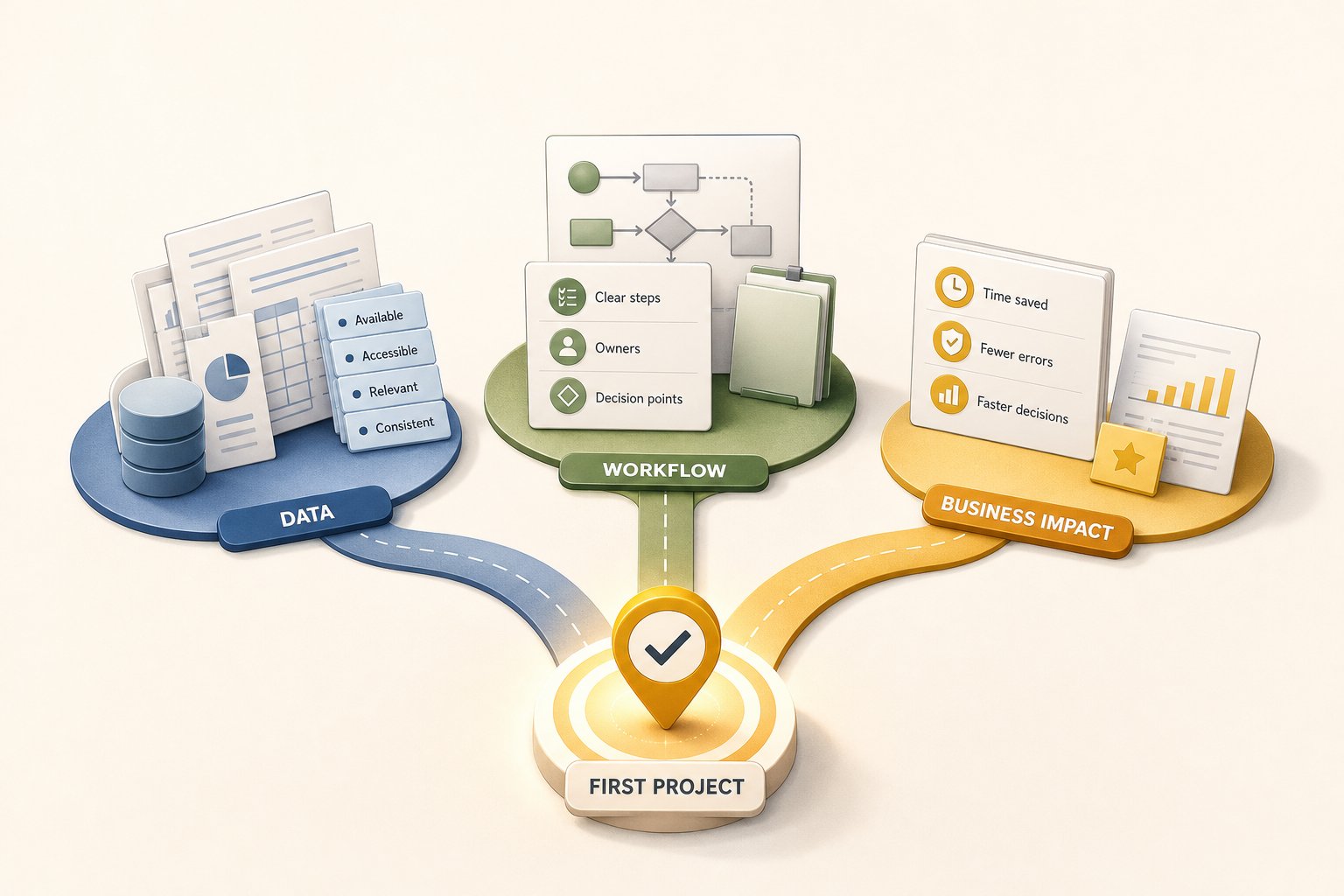
Once you have a possible use case, assess it on three dimensions: data, workflow and business impact. If one of these is weak, the project may still be possible, but it is less likely to be a sensible first step.
| Area | What to look for | What can go wrong |
|---|---|---|
| Data | Available, accessible, relevant and reasonably consistent information | The data exists but is spread across systems, incomplete or hard to use |
| Workflow | A process with clear steps, owners and decision points | No one agrees how the process actually works |
| Business impact | A measurable gain such as time saved, fewer errors or faster decisions | The value is vague or too small to justify the effort |
Data quality does not have to be perfect, but it does need to be usable. A first project often fails because the information is technically available but not in a form the team can work with. That might mean inconsistent naming, missing fields or multiple versions of the same record.
Workflow clarity matters just as much. If the process is not understood by the people doing it, AI will not fix that. In practice, the project may need a short process mapping exercise before any solution design begins.
Business impact should be expressed in operational terms. “Better efficiency” is too broad. “Reduce the time spent on internal ticket triage” or “cut manual review of incoming forms” gives you a basis for deciding whether the project is worth pursuing.
Choosing between a quick win and a strategic opportunity
SMEs often face a choice between something small and fast or something more strategic but harder to deliver. Both can be sensible. The wrong choice is usually the one that ignores readiness.
A quick win is a use case with a contained scope, a narrow workflow and a visible improvement. It is useful when the organisation needs confidence, internal buy-in or a clearer view of how AI fits into day-to-day work. It can also help teams build a better understanding of what implementation really involves.
A strategic opportunity is broader. It may sit closer to a core process, support a larger volume of work or affect a more important decision. It can create more value, but it usually needs better data, stronger process discipline and more change management.
For a first project, quick wins are often the safer choice if you want to prove value without tying up the business in a long programme. Strategic opportunities are better when the process is already well understood and the organisation is ready to support a more involved implementation.
A simple decision rule helps:
- Choose the quick win if you need speed, proof and internal confidence.
- Choose the strategic opportunity if the data and process are already mature.
- Avoid the “biggest possible” use case if the team cannot support it properly.
- Avoid the “easiest possible” use case if it will never create meaningful value.
That balance is central to practical ai for smes. The goal is not to start with the flashiest idea. It is to start with the one that can succeed in your actual operating context.
What to do before speaking to an AI consultancy
Before you speak to an AI consultancy, gather enough detail to have a productive conversation. You do not need a fully scoped project. You do need a clear problem.
Bring three things:
- A description of the workflow you want to improve.
- An example of the inputs, outputs or decisions involved.
- A rough view of what better looks like, such as time saved, fewer errors or faster turnaround.
If you can also note who uses the process, where the data lives and what is getting in the way today, the discussion will move faster. That gives a consultancy a basis for judging feasibility without turning the first conversation into a technical deep dive.
For Hally AI, that is usually the most useful starting point. We can help identify which idea is worth exploring, which ones should wait and what kind of implementation support the business would need if the use case is a good fit. The point is not to commit to a project on day one. It is to reduce the field to one practical opportunity with a realistic chance of success.
A sensible first choice is usually the one you can explain clearly
If you can explain the use case in plain English, point to the workflow it affects and describe how success will be measured, you are probably close to a good first project. That is the right standard for the first AI opportunity in an SME internal systems project.
Start with the problem, not the technology. If you want a low-pressure next step, a short discovery conversation or AI opportunity assessment can help narrow the options before you commit time and budget.