Professional services firms do not need AI to replace expertise. They need it to make expertise easier to access, easier to route and easier to use consistently.
That matters because firms such as accountants, agencies and consultancies rely on judgement, context and trust, but they still run on recurring internal work: finding prior answers, preparing handovers, summarising client material, checking delivery steps and locating the right person to ask. An internal AI system earns its place when it reduces that friction without getting in the way of client work.
For partners, directors and operations leaders, the question is not whether AI can automate isolated tasks. It is whether it can sit inside the firm’s day-to-day operating rhythm and support better decisions, smoother delivery and more reliable knowledge flow. That is where practical AI consultancy for SMEs becomes useful: not as a technology exercise, but as a way to identify the right AI opportunity, design a fit-for-purpose solution and implement it in a way people will actually use.
Why professional services still need internal systems
Highly skilled firms can still be surprisingly inconsistent internally.
One consultant may keep excellent notes. Another may rely on memory. One account manager may know exactly where the latest proposal sits. Another spends fifteen minutes searching shared drives, inboxes and chat threads before asking a colleague. None of that means the firm lacks expertise. It means the expertise is not always packaged in a way the business can reuse.
An internal system gives structure to work that would otherwise live in individual habits. In professional services, that structure matters because delivery quality depends on more than one person’s memory. It depends on how well the firm captures what it knows, routes requests and keeps recurring tasks from being rebuilt every time.
AI should strengthen that structure, not flatten it. The aim is to reduce the amount of time people spend hunting for information, recreating basic outputs or working out who owns the next step. That is a practical SME operating system use case: not a grand transformation, but a more dependable way of getting knowledge to the right place at the right time.
Where AI supports research, summaries and handoffs
The most useful internal AI systems in professional services usually sit between people, not in front of clients.
A good place to start is work that needs interpretation, but not fresh expert judgement every time. That often includes:
Research support
AI can help pull together a first pass on background material, internal precedents or client context. The value is not that the output is finished. The value is that a team member starts with a structured draft instead of a blank page.
Summaries
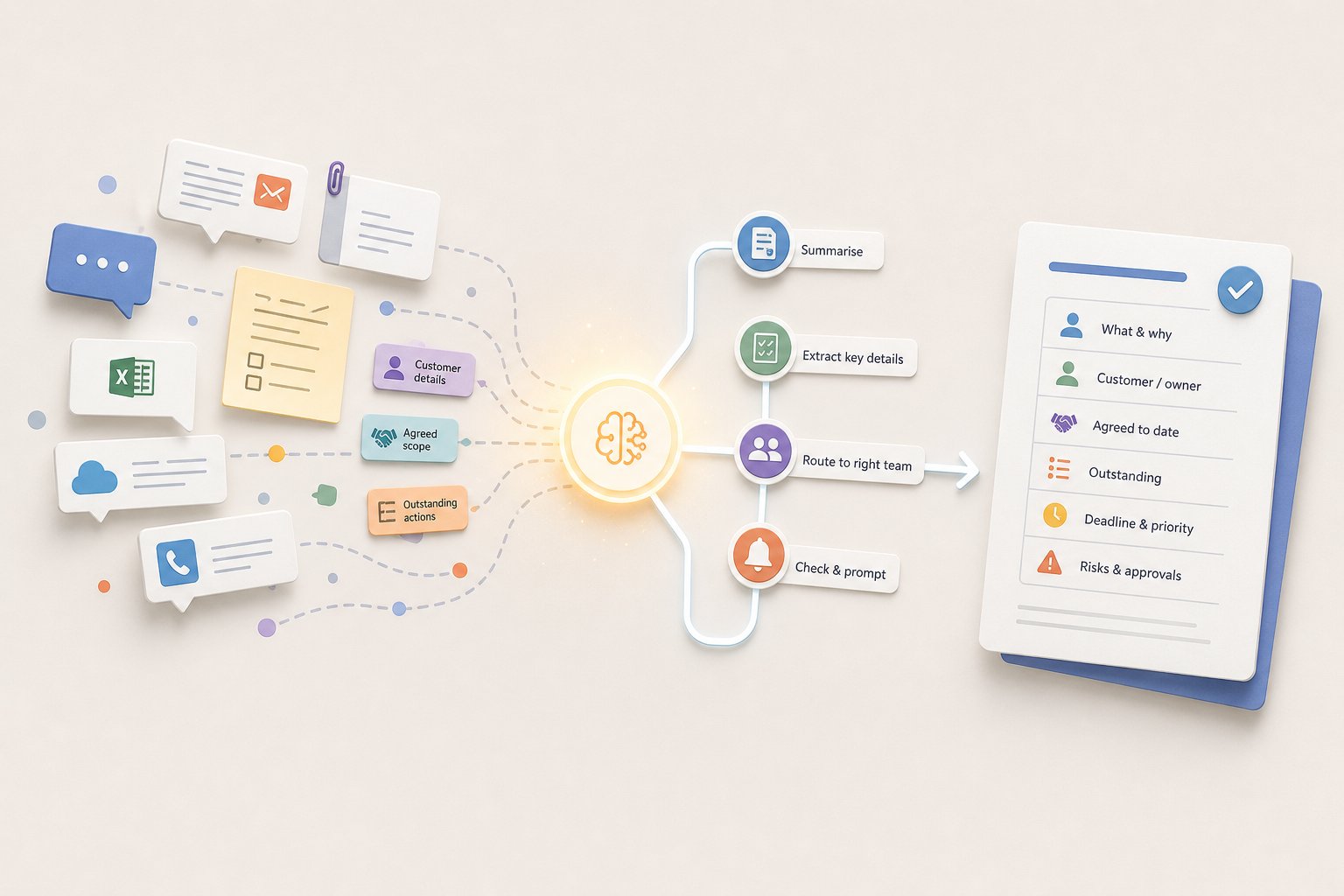
Meetings, long email threads, project notes and document sets can all be condensed into a shorter brief for the next person in the chain. That is especially useful where the handover needs to preserve nuance without forcing someone else to read everything from scratch.
Internal handoffs
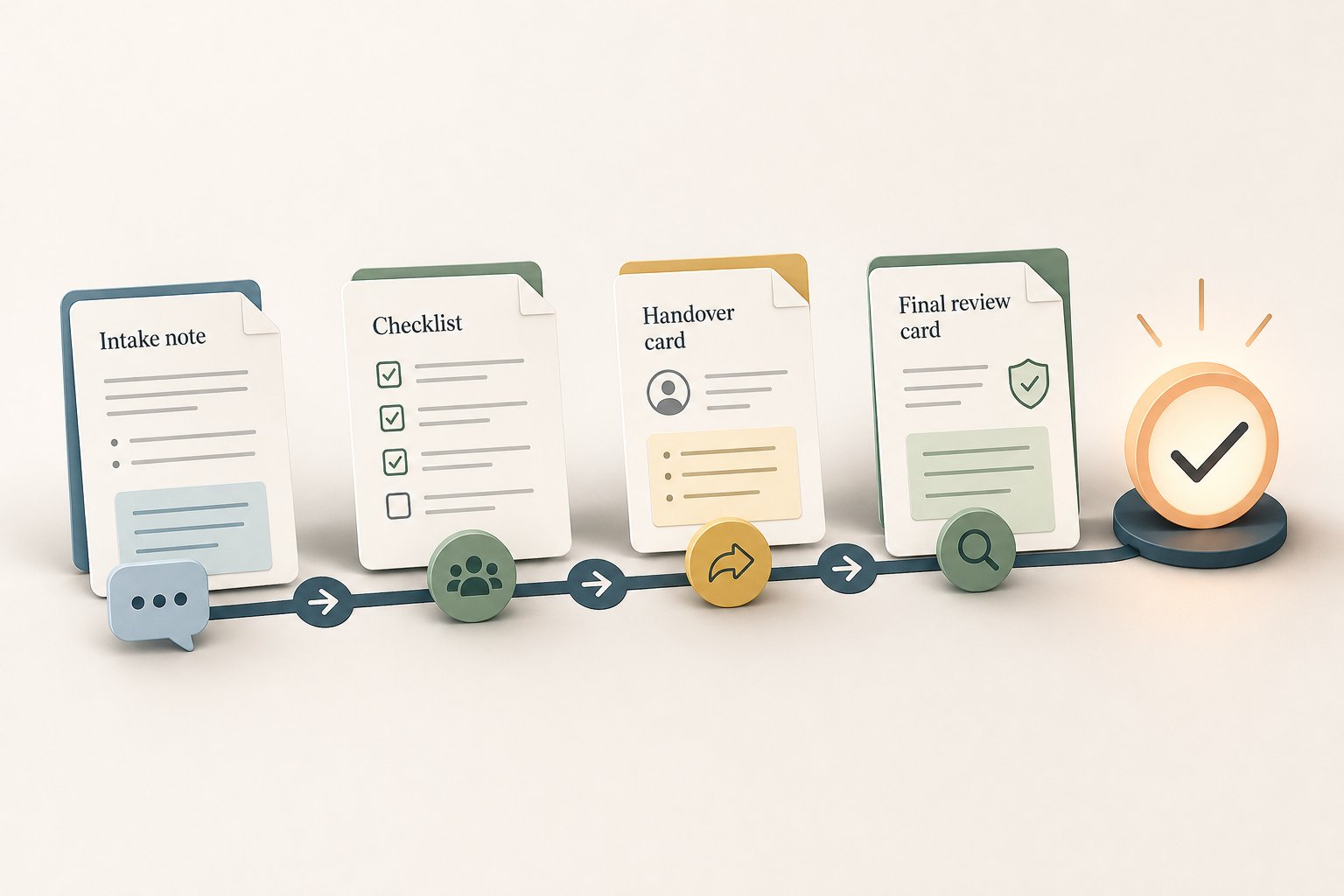
Many delays in service firms come from incomplete transitions between sales, delivery, account management and operations. AI can help assemble a handover pack, surface missing fields and highlight unresolved questions before work moves on.
Used well, these functions save time without weakening professional judgement. The key is to treat AI as a support layer. It can assemble, sort and pre-digest information, but a human still needs to decide what matters, what is missing and what should be challenged.
How to standardise recurring workflows without losing quality
Professional services firms often resist standardisation because they worry it will make work generic. That is a fair concern if standardisation is treated as a rigid script.
The better approach is to standardise the parts of delivery that should be repeatable, while leaving room for judgement where the work genuinely needs it. AI is useful here because it can support consistent process without forcing every interaction into the same shape.
A sensible pattern is to identify recurring workflows such as:
- new client onboarding
- proposal preparation
- project kick-off
- meeting follow-up
- status reporting
- issue escalation
- final delivery review
For each one, the system should know what information is needed, who needs to see it and what the next step usually is. AI can then help route the work, prompt for missing details and produce a first version of the relevant summary or task list.
This is where the balance matters. If the workflow is too loose, people interpret it differently and quality drifts. If it is too rigid, people work around it. The right internal AI system gives enough structure to protect consistency, but enough flexibility to let senior staff apply judgement where the context demands it.
Making knowledge easier to find and use
Most firms already have knowledge. The problem is access.
Useful material is often spread across shared drives, inboxes, slides, notes, templates and someone’s memory of “that project from last year”. The result is not just wasted time. It also creates uneven delivery, because the person who knows where things are becomes the bottleneck.
An internal AI system can help if it is built around retrieval, not just content generation. That means making it easier to find the right precedent, policy, template or answer in the moment someone needs it.
For professional services SMEs, this often comes down to three design choices:
Keep the knowledge base narrow enough to trust
A smaller, well-maintained source of truth is usually more useful than a sprawling library that nobody trusts.
Link AI to the firm’s own material
Generic answers are not enough for client-facing professional services work. The system needs to draw on the firm’s documents, procedures and approved examples where possible.
Make the output usable, not merely readable
A good answer is not just a paragraph of text. It might be a checklist, a suggested email draft, a summary of risks or a prompt to consult a specific colleague.
This is one of the clearest ways AI can create capacity quickly. If people spend less time searching and less time repeating internal explanations, they have more time for client work, review and decision-making.
What a sensible rollout looks like
A sensible rollout starts small and useful.
For SMEs, the main risk is not moving too slowly. It is starting with a broad AI ambition that sounds impressive but is difficult to embed. Internal systems work better when they are introduced around one painful process, one team or one recurring knowledge problem.
A practical rollout usually looks like this:
- Choose one internal friction point.
Pick the place where people are repeatedly wasting time or making avoidable errors.
- Define the desired output clearly.
Decide what the system should do, what it should not do and who remains responsible for the final decision.
- Use existing work patterns as the starting point.
Build around how the firm already works, then improve the weakest steps rather than inventing a new process from scratch.
- Test with a small group.
A few users will show quickly whether the system is actually helpful or just theoretically useful.
- Refine for trust and adoption.
In a professional services setting, people will only use the system if it is accurate enough, easy enough and clearly useful.
- Expand only after the first use case is stable.
Once one workflow is working, the next one is easier to define and defend internally.
This approach avoids the common trap of building AI for its own sake. It keeps the focus on practical solutions, measurable value and changes people can adopt without disrupting client delivery.
A useful internal AI system should make expertise easier to apply
For professional services firms, the right internal AI system is not the most ambitious one. It is the one that helps the firm use its knowledge more consistently.
That usually means better handoffs, faster access to internal information, more reliable recurring workflows and less time lost to searching, summarising and re-explaining. The goal is not to remove the judgement that makes the firm valuable. It is to give that judgement better support.
If you are exploring where AI could create capacity in your own firm, start with one process that repeatedly slows people down. A short discovery conversation or AI opportunity assessment can be enough to identify where a practical system would save time, improve decision-making and support better delivery.